Redeye VC

Josh Kopelman

Managing Director of First Round Capital.

espite being coastally challenged (currently living in Philadelphia), Josh has been an active entrepreneur and investor in the Internet industry since its commercialization. In 1992, while he was a student at the Wharton School of the University of Pennsylvania, Josh co-founded Infonautics Corporation – an Internet information company. In 1996, Infonautics went public on the NASDAQ stock exchange.

Read more or visit First Round Capital

Medical Research 2.0

I recently returned from the TED conference -- an annual conference that, as they describe it, "brings together the world's most fascinating thinkers and doers…" The speakers at this conference both motivated and scared me. I walked away with a very similar feeling to Rick Smith. And I, like many other people, left the conference motivated to make a positive impact on the world.

But, I'm not likely to develop weapons against drug-resistant superbugs (like Bonnie Basser), to develop new surgical robots (like Catherine Mohr), or prevent pandemics before they happen like epidmiologist (like Nathan Wolfe). I'm just an Internet guy. What can I do?

It was when I heard Tim Berners Lee speak about Linked Data at TED that I had an idea. I've been blogging about the Implict Web for some time now. Specifically, I believe that as people conduct more of their life online, they leave a mountain of digital breadcrumbs (also called data exhaust). Historically, this data has existed in silos. Amazon knows what books I like. Netflix knows what movies I like. OpenTable knows where I eat. But as more website adapt web services and build APIs, this data can be used in new and unexpected ways. And I believe that tremendous value will be created when someone can" cross the silos". Google's PageRank, for example, is a perfect example of data exhaust. It's a set of data (webmasters HTML links) that was created for one purpose, but adds a ton of value when used in a new way (search).

So, here’s my latest hypothesis:
I believe that we're rapidly reaching a point where we can learn as much about disease causation by leveraging internet breadcrumbs as we can from traditional medical studies.

For example, there has been an ongoing controversy over whether the use of antiperspirants/deodorants increase the risk of breast cancer. While there have been several studies done to date, the results haven’t provided conclusive data. Indeed, the National Cancer Institute has said: “Because studies of antiperspirants and deodorants and breast cancer have provided conflicting results, additional research is needed to investigate this relationship and other factors that may be involved.”  While I’m not a medical researcher or statistician, I’m amazed about the low sample sizes of these studies. For example, the most recent study cited by the NCI had just 104 people in it. The study before that had only 437 people in it.

What if we asked people to opt-in to participate in a Medical Data Pooling Project?  Users would voluntarily contribute their data exhaust (without any personally identifying information) for medical research.  Every year hundreds of thousands of people support the fight against breast cancer by walking/contributing to walkathons (the Susan G. Komen Walkathon, The Avon Walk for Breast Cancer).  What if we asked them to join a linkathon -- just link your data to this nonprofit medical data pool?

For example, CVS has 50 Million people who have enrolled in Extracare (their loyalty program). I sure bet a lot of them are women who buy deodorant at CVS.  And if you don’t shop at CVS, you probably buy deodorant at a supermarket that has a loyalty program (most likely run by Catalina Marketing). What if a researcher was able access this global consumption data and target a segment of the population (say, 50,000 women above the age of 40 who buy deodorant 4 times a year or more, for example) and then survey them about their medical history? The ability to link to consumption to medical condition would be extremely valuable. The power of this linkage could be immense.

Take the debate over whether the chemicals used in dry cleaners (PERC) cause cancer. With over 600,000 users tracking their expenses, I’m sure that Mint.com would be an invaluable data set for medical researchers. Want to study if prolonged cell phone usage causes cancer? Skydeck collects your cell phone usage data.

Convincing users to anonymously part with their data and answer some medical questions is not going to be easy...BUT, it should be a lot easier than convincing them to participate in clinical trials.  Current non-profits could be enlisted to get their membership to participate (ie, it might be easier to get someone to donate their data exhaust than to give money or participate in a fundraiser).  And I have to think that the database providers would love this -- after all, this would (1) potentially encourage more consumers to participate, (2) benefit society and (3) provide them with a compelling argument to all those people who oppose database marketing.

Anyone up to working on this with me? What am I missing?
The Giving Tree and The New York Times

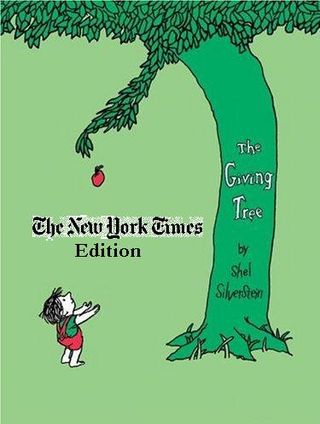
The_Giving_Tree The other day I read The Giving Tree to my son as I was tucking him in to bed.  I remembered the book from when I was a kid. 

The book tells the tale of a relationship between a boy and a tree.  In the early days, the relationship is wonderful.  The boy and the tree are great friends – and the boy enjoys climbing the tree’s trunk, swinging from it's branches, eating its bountiful apples, and sleeping in it’s shade.  But then time passes.  And as the boy gets older, the relationship changes.  The boy comes back to the tree when he needs money, and the tree gives him its apples to sell in the city.  Years pass.  The boy needs a house, and the tree gives him its branches to build a house.  Years pass.  The boy wants a boat, and the tree gives him its trunk to make a boat.  The boy returns one more time, this time as an old man.  And the tree, which is now just a stump, has nothing more to offer him.  But all the man wants to do is sit down to rest.  And he sits on the stump...
 
Many people have written about the book, and there is much debate as to whether the tree is "selfless or merely self-sacrificing, and whether the boy is selfish or reasonable in his demands of the tree".

As I finished the book and put my son to bed, a thought hit me.  We’re watching a real-time unfolding of The Giving Tree right now.  It’s called the implosion of the NY Times.  In this story, the role of the boy is played by the Internet... 

In the Internet's youth, it looks up to the big tree (the NY Times) -- and they play nicely together and become friends.  But, the tree didn't understand the true cost of a friendship with the boy.  And as time passes, the NY Times is going to be forced by the Internet to sell it’s building.  It will sell it’s stake in the Boston Red Sox.  It will ultimately sell it's stake in the Boston Globe and About.com.  It will charge a subscription for web users.

And in the end, the New York Times will just be a stump.   

It may be a few years off, but I'm pretty sure I will be reading the "NY Times Edition" of the Giving Tree in the next few years.  But in the meanwhile, it does provide a cautionary tale about disruptive technology.  And all CEO's around the world should ask themselves:  Does my company have any relationships (with other companies -- or with new technologies) that are starting off friendly (and mutually beneficial) but could evolve to be one-sided? 

My Top 10 Blackberry Applications

I recently had to upgrade my Blackberry, and as a result, had to re-install all of the applications I had previously installed.  I have yet to find a good, concise list of useful Blackberry Applications -- so I thought I'd post mine.  I'd love to hear any thoughts/suggestions for other apps to install.


AIM - http://mobile.aol.com/aolproducts/aim-for-blackberry-directions

Facebook - http://na.blackberry.com/eng/devices/features/social/facebook.jsp#tab_tab_download

TwitterBerry - http://www.orangatame.com

Google Applications (Search, Maps, Reader, Docs) - http://www.google.com/intl/en_us/mobile/blackberry/

Yammer - http://www.yammer.com/blackberry/download

Berry Bloglines - http://www.thebogles.com/berrybloglines.jad

Wall Street Journal Mobile Reader (my favorite News Application) - http://www.wsjmobilereader.com

Berrystore - http://m.berrystore.com

Myspace - http://www.myspace.com/blackberry

CNBC (shortcut) - http://mobileapps.cnbc.com/mobileLoad.do

NY Times (shortcut) - http://mobile.nytimes.com/bbinstall

ESPN (shortcut) - http://espn.mobi/bblauncher

Weather Channel (shortcut) - http://xhtml.weather.com/xhtml/launcher


Happy Holidays...

Frc It was sometime in August when I first saw the Where The Hell Is Matt video. It had just gone viral, and unlike most other "viral videos", I thought Matt's video was moving, fun and uplifting -- it was a great way to showcase the differences and similarities between 40+ different countries.

Then I had the idea. What if we filmed a similar video with our 40+ portfolio companies. And thus began the quest to film our holiday video. My partners and I kept our Flip cameras in our briefcases, and starting in August, whenever we went to visit our portfolio companies we invoked the "dancing" clause in the term sheet. As you can see, we all had a blast.

And then the market crashed. My partners and I discussed scrapping our little holiday project. But the more we talked about it, the more we were convinced that we should continue. While our companies were all facing up to the new realities -- and in some cases, making some tough choices -- it didn't mean that they couldn't take 15 seconds to have some fun. In times of adversity, maintaining perspective and an espirit-de-corps is even more important than ever.

I look forward to "keeping on my toes" this year with all of you. Best wishes for a happy and healthy holiday season -- and let's hope we all have something to dance about next year...

Road Trip!

As we've grown First Round Capital over the last several years, I've come to believe that there are three types of value-add that venture capital firms can add to portfolio companies. 

  • The first is the money.  There is no differentation or value-add here.  Every investor's money is the same.

  • The second is the value that the specific people (partners, principals, associates) at a venture firm add.  Let's call it "people" value.  Can your VC help you with your distribution strategy?  Can they help you build your team?  Can they connect you with a partner?  This value is dependent on the skills and rolodex of the particular VC that a startup is working with -- as well as the amount of time they can allocate to your company.

  • The third level of value is what I call "structural" value.  This is the value that the firm can bring outside of any specific partner interaction -- it is scaleable, institutional value-add.  While I think that my colleagues and I add a tremendous amount of "people value", we really spend a great amount of effort trying to add structural value to our portfolio companies.


This is why we hold our annual CEO Summit - which has featured speakers from Corporate Development at major Internet players (such as Google, Yahoo, AOL, CBS, Microsoft, and Fox Interactive), Bloggers and press (like Michael Arrington and Henry Blodget), evangelists from up-and-coming platforms (like Facebook and Amazon), and valley veterans (like Marc Andreessen).

It's why we have operate a well-used mailing list for our portfolio company CEO's and CTO's to share best practices and ask each other for assistance. 

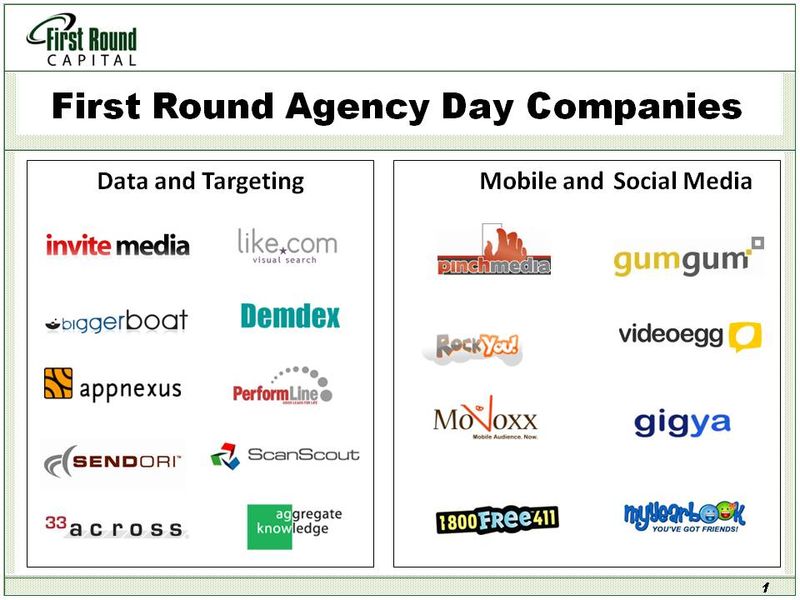
And it's why we just completed our "First Round Capital Agency Days" in New York City this week.
 
As we worked with our portfolio companies, one of the things we’ve been hearing loud and clear is that our advertising-related companies would like to have deeper relationships with large ad agencies. 

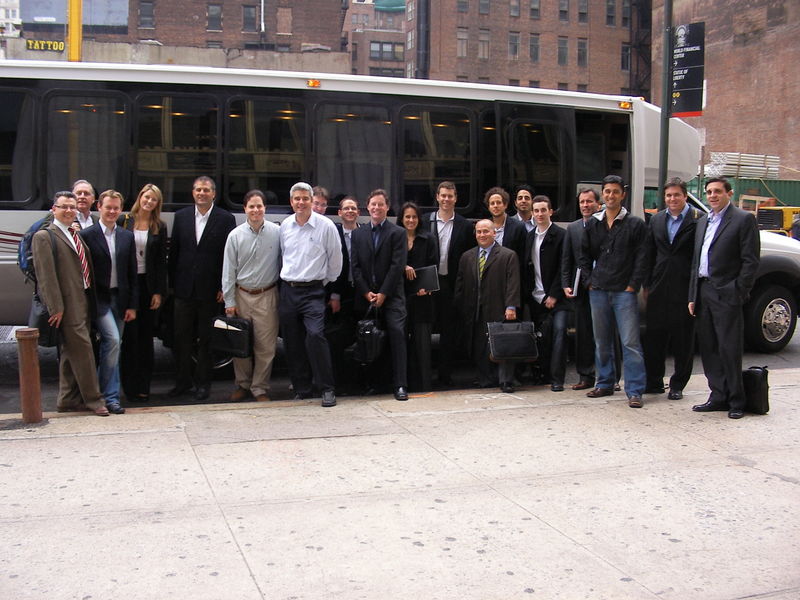
So this week my partner, Chris Fralic, organized a two-day road trip to the four largest advertising agencies in country.  We rented a bus, and drove our companies to meet with WPP, Digitas, OMG and Universal McCann.  This gave our portfolio companies the opportunity to present to over 100 media buyers, account executives and strategists.  These four agencies control a major portion of total US ad spending.  The response was so strong that we’re going to do it again in the spring.  

Thanks to all the companies (below) and agencies for making the event so successful -- and Chris for organizing a wonderful event!

Companies

The Business of API's

Logo_apiconference


First Round Capital portfolio company, Mashery, will be hosting their third annual Business of APIs conference, coming up on Monday, November 3rd in San Francisco.

As its name suggests, "The Business of APIs" is not a technical conference. It is a place where the people responsible for bringing in revenue, building traffic or building content syndication channels will learn how some of the most prominent and successful media and internet companies are enjoying significant growth through building a web services distribution channel.

In this one-day conference you will learn from companies that have executed API strategies to reinvent their businesses. They will share why and how they did it, what they expected to achieve, and how they are measuring success. It will be a day of real-world advice and lessons learned from many of your peers who are already part of the Web's Industrial Revolution.

Confirmed speakers include:

  • Heidi Tucker, VP of Business Development, Hoover's
  • Marc Frons, CTO, New York Times
  • Mike Hart, Director of Engineering, Web API, Netflix
  • Daniel Jacboson, Manager of Application Development, NPR Digital Media
  • Clay Webster, Associate Vice President Platform Infrastructure, CBS Interactive
  • Michele Azar, Vice President of Emerging Channels, Best Buy
  • Allen Hurff, Senior Vice President of Engineering, MySpace
  • Aaron Patzer, Founder & CEO, Mint.com
  • Quentin Hardy, Sr Editor and Silicon Valley Bureau Chief, Forbes

This is only a partial list of speakers; more will be announced in the coming days. Information about the conference can be found at: http://www.apiconference.com

Use the discount "BAPI" code and register for only $199 - a savings of 33%!

First Round Capital Office Hours (and Free Coffee)

OfficehoursCORRECTION - My initial post had the wrong date.  The correct date is Tuesday, October 21st.

We live in interesting times.   Despite the recent doom and gloom forecasts for startup companies, we at First Round Capital are still investing in new companies and actively seeking talented entrepreneurs to back.  My colleagues on the west coast are holding our first Office Hours next Tuesday.  As Kent wrote in his blog post:

"At Office Hours, we’d love to meet with entrepreneurs, people thinking about becoming entrepreneurs or folks who would like join a start-up. We’ll be available for a bunch of informal ~15 minute chats. There’s no agenda. Ask us what we think of the market environment or share an idea for a company – we’ll be sure to have plenty of napkins available to help draft that first product plan. We’ll listen, share our perspective and pay for the coffee (which may be of more value than our advice).

When: Tuesday, October 21st , 11am – 1pm
Where: University Café, 271 University Ave, Palo Alto, CA 94301

All are welcome -- if you think you'll drop by, please RSVP, so they can get a sense of how many people are coming.   I'll be in town that week, so I'll be there from 11 until noon...