Redeye VC

Josh Kopelman

Managing Director of First Round Capital.

espite being coastally challenged (currently living in Philadelphia), Josh has been an active entrepreneur and investor in the Internet industry since its commercialization. In 1992, while he was a student at the Wharton School of the University of Pennsylvania, Josh co-founded Infonautics Corporation – an Internet information company. In 1996, Infonautics went public on the NASDAQ stock exchange.

Read more or visit First Round Capital

Follow the leader?

You_are_invited Whenever First Round Capital holds a party, we sometimes get emails from a few of our guests asking if they can bring another person with them.  Maybe a VC friend of ours wants to bring another partner with him.  Maybe it’s an entrepreneur who wants to bring a new executive hire.  Maybe it’s someone who works at Facebook and wants to bring a co-worker.  Unless we’re dealing with a venue that has a limited space, we typically are fine with the extra guests.  It’s a great way to expand our network – and meet new, interesting people.  The few times we weren’t able to accommodate those requests typically were due to hard constraints (either budgetary or the size of the venue).  And when we don’t have room, we tell that to the person who asked – and they typically are very understanding. 

I just read my friend, Roger Ehrenberg’s, latest blog post on syndicating seed rounds – and totally agree with his main conclusion (that rounds tend to work best if there is a lead investor to represent the interests of the syndicate).  But the most meaningful part of Roger’s post, in my opinion, is when he writes about how a syndicate gets chosen.  Specifically, he writes: ‘One can have a reasoned discussion concerning capacity, etc., but fundamentally if an entrepreneur wants a particular investor in I am going to make room – period.’   I could not agree more.  I think that the entrepreneur should be the “decider” on the syndicate – not the lead investor.  The lead investor should help establish terms, provide feedback and input on potential co-investors, and bring other investors to the table if asked/needed – but the lead investor should not force a syndicate on the entrepreneur.  

If I’d react badly to a guest trying to force me to let another guest into my party for a few hours (ie, “the only way I’ll come is if you let this stranger in”), I can only imagine how badly I’d react if I was an entrepreneur that was forced  to spend the next 5+ years with someone I don’t want.  In my view the lead investor should offer feedback and offer introductions – but ultimately should follow the founder’s lead on syndicate composition.  If the founder wants certain angels to participate – done.  If the founder thinks that a certain fund could add value – done.   

Just like I think that financing rounds should be based on company math (as opposed to venture math), I think the syndication decision belongs with the founder (as opposed to the investor).  The founder should be free to choose the investors that increase the company’s odds of success.  And building a syndicate is the entrepreneur’s opportunity to figure out who the founder wants to spend time with, who the founder respects, and who the founder thinks can help the company the most.  

Oftentimes the first strategic discussion that a lead investor gets to collaborate with a founder on is the discussion around the syndicate.  And while I'd clearly expect a reasoned conversation to occur, I believe that an early stage investor is funding a company because they believe in the entrepreneur's ability to make strategic decisions and to optimize for success.  And ultimately, it should be the investor who follows the founder's lead when it comes to syndicate composition (and not the other way around).

Location in the Cloud

I just read the news about Google's upgrades to Google Latitude -- and boy is it a bold move with major implications.  If done right, I think it could ultimately be as transformative as when Facebook opened up the social graph. 

Before Facebook opened up their social graph, if a web site wanted to know your relationships/friends it had to ask you.  Each and every time.  Then came Facebook Connect.  What Facebook did with Facebook Connect is to build out (1) a utility/infrastructure that enables third-party sites to gain access to your social graph, and (2) a permissioning model that gives users control of what third-party sites can access your data.  While there are a number of privacy issues that Facebook is working out in public, I believe that they will be ultimately resolved -- and that Facebook's social graph will become integrated throughout the net.  

And today, Google announced a similar model for location data.  Previously, whenever an application or website wanted to know where you were it had to ask you for permission to obtain your location from your phone.  Each and every time.  With Google Latitude's new API they are changing the game.  Rather than have dozens of applications that each ask for your location, Google's Latitude application will keep track of your location -- and put it in the cloud.  And then users can authorize third-party applications/sites to access their data.  Three million users already use Google Latitude, making it one of the largest location-based services around. 

Assuming Google can work out the privacy implications (which are non-trivial), there could be hundreds of potential applications, like:

  • Imagine linking your ATM or Credit card with Google Latitude. If you want to make a large ATM withdrawal or charge more than $1,000 -- your bank can check with Google Latitude.  If your phone is more than 500 feet from the transaction point, they might be alerted to fraud.
  • What if you could link your online photos with Google Latitude.  Your photos could be automatically tagged with your location -- just by looking up where your phone was at the time.
  • When you visit a website (like OpenTable or Fandango) on your desktop computer, it can look up your phone's location via Google Latitude and deliver a personalized experience.
  • I could be automatically notified when out-of-town friends come to town -- or my meetings could be notified when I'm running late.
  • Companies can use Google Latitude for expense report creation -- or even to replace time cards.

How often does someone go more than 200 feet from their cell phone?  In my experience, not often.  In today's world, your cell phone is now a personal location beacon.  And by making it programatically accessible in the cloud, Google could enable an entirely new class of applications. 

Combine this new ability to obtain location from the cloud with the types of tools and data overlays that SimpleGeo (a First Round Capital portfolio company) offers -- and developers now have an amazingly robust set of tools to build upon.    I can't wait to see what they build...

Size Matters (at least for venture funds)

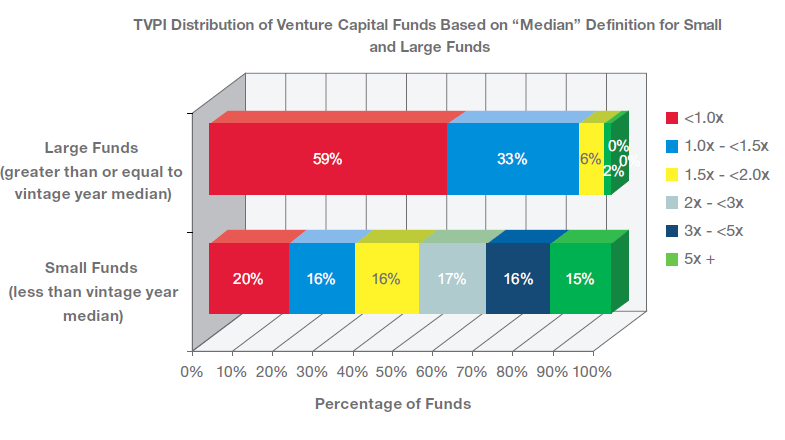
 I've previously written several blog posts about venture capital fund size -- and how it impacts fund performance.  I just came across a report that Silicon Valley Bank wrote last month which had some amazing data on fund-size and performance. 

While I would recommend that you download and read the entire report, I think that the chart below tells a powerful story.  Specifically: 

If you were to look at the performance of large funds (those greater than or equal to the vintage year median size) for venture funds between 1983 and 2003, just 2% of the large funds returned more than 2x contributed capital.  And 92% of the funds returned less than 1.5x capital.  But if you were 24-logo-1to look at the performance of the small funds (those less than the vintage year median size) for those same years, the performance is much better.  Indeed, 48% of those funds returned 2x -- or, put another way, small funds were 24 times more likely to produce returns above 2x than large funds.  And just 36% of small funds returned less than 1.5x capital.  Wow.  And this is not some small sample -- the SVB study included the returns of more than 850 venture firms...

 Svb

Early investing = Early adopting

Screen-shot-2010-04-21-at-11-04-10-am As seed-stage investors, First Round Capital invests early in a company's life.  Typically we're funding PowerPoint slide decks -- and are investing in pre-product, pre-revenue companies with incomplete teams and uncertain business models. The reason we're able to take this much risk is because we only invest in areas we really know:  Internet-enabled businesses (both enterprise and consumers).  By restricting our investments to a specific focus, I find that we are (hopefully) able to leverage our experiences and industry knowledge to help us make smart investment decisions.  My own experiences in eCommerce, for example, have been very helpful to building our investment hypothesis in that area...

One of the best ways for us to stay informed about the industry we invest in is to be hands-on with the technologies that impact the market.  My partners and I were some of the earliest venture bloggers.   We were among the first 140 Twitter users (though I'd gladly trade my early adopter Twitter user-number for Fred Wilson's Twitter equity).  And our recently redesigned First Round Capital website, provides us with a very valuable sandbox from which to explore new web technologies.  The integration of data into the First Round Capital News Feed (including job postings, company news, new investments, tweets, and even foursquare checkins) has helped us better understand the power (and limitations) of the implicit web.

And that's why, when Facebook announced the launch of their distributed "Like Button" today at their f8 conference -- we jumped on it.  Just a few hours ago Facebook launched a feature that allowed publishers to leverage Facebook's social connections inside their own sites.  And they rolled out the feature with over 30 major publishers participating in the launch.  Big publishers such as CNN and ESPN.  And I'm happy to announce that First Round Capital has just joined the list.  The news feed on our homepage now integrates into Facebook - bringing the social graph onto to our site...and hopefully leveraging Facebook to drive incremental traffic.

I think that by being hands-on with new technologies, you can get a good sense of the possibilities they unlock.  And so far, I'm very impressed with the ability to bring social interaction onto our site.  (And I am also impressed with our in-house product manager - who was able to get it live in less than 12 hours after the announcement).

Calling London - A Volcanic Opportunity

Volcano What a bizarre world we live in.  My partner, Chris Fralic, has found his trip to London "indefinitely extended" due to a volcano in Iceland.  So he's decided to put together a last minute "Office Hours" tomorrow, Sunday.  I know it's last minute - but it's worth a try.  If you are an entrepreneur in London (or thinking about becoming one), I'd suggest you sign up and stop by:

DATE:  Sunday, April 18th, 2010

TIME:  1300 to 1500 (That's 1PM to 3PM for the rest of us)

LOCATION:  White Bear Yard, 2nd Floor, 144a Clerkenwell Road EC1R 5DF LINK

You can SIGN UP HERE

What can you expect at Office Hours London?  The chance to meet up with someone from First Round Capital to get to know us a bit better, and for us to get to know you and your idea or company.   You'll also have a chance to mingle and interact with folks from other startups, which could be worth the alone -and we'll try to have some tea and coffee and snacks as well.

Have we ever funded a company we've met at Office Hours?  Yes we have, in fact it was just over a year ago at Office Hours New York that we met David Roth, CEO of AppFirst.  We invested along with FirstMark and just yesterday they officially launched at Under The Radar and won the audience and judges award in their category.  

Given the short timeframe, I'd appreciate any help in retweeting this or forwarding this to London-based entrepreneurs.  Thanks!

The importance of communication...

I am now experiencing full withdrawal symptoms.  It has now been almost a day and a half without access to my e-mail.  We use Intermedia to host our e-mail -- and have historically found them to be very reliable.  They are the world's largest provider of hosted Exchange.  And their service level agreement "guarantees 100% data protection and less than six minutes of Exchange hosting downtime per year".  Well, they are now 1,680 minutes past their six minutes guarantee...


This outage has shown me just how much I rely on email communication.  But it's also shown me how much I've come to expect open, transparent and constant communication from a vendor.  I totally get that despite every precaution, an outage can occur.  I get the fact that despite Intermedia's massive investment in DataEcho™ technology that securely replicates Exchange data across two of their four datacenters, the system can crash.  It might be human error.  It might be a hardware failure.  Shit happens.


What I don't get is why Intermedia has been so poor in their communication.  The "Network Status" page on their website reads as if it is targeted towards IT folks rather than people.  While it tries to explain mail queing, it never says "Hey...we're sorry.  We know we took down your email and that's not acceptable."  There has been not one post on their blog during this outage -- and the last post is still a whitepaper highlighting the benefiuts of outsourced Exchange hosting.  The last update on their twitter account is 19 hours old and inaccurate, stating that "At this time all services are online and functional..."  The Intermedia phone lines are unreachable.  And the homepage of their website has not changed at all -- with the "What's New" section not updated since March 4th.  


You want me to tell you what's new???  Your service has been out for more than 24 hours.  I was almost unable to file my taxes yesterday (and god help any accountants that used Intermedia) and my partner is stuck in London because of a volcano.  We're not getting email and you aren't talking to me!


For a company that is in the business of helping people manage their digital communications, Intermedia's failure to communicate is an inexcusable failure.  It has reinforced to me the importance of open and transparent communications.  I'm not saying they need to add a live stream to their homepage like First Round Capital has.  Just that they should use the tools they already have (their homepage, their blog, their twitter account and their network status pages) to talk with their customers.   


Now, given the fact that you historically have been so reliable and operated with virtually no downtime, I would assume that you've built your customer communications plans on the assumption that outages will be short and temporary.  I agree that if you are down/slow for 4 minutes, you don't need to re-write your homepage and put out a press release.  But I do think you need to have a completely different communication plan when faced with a massive failure.


When US Airways flight 1549 crashed in the Hudson River last year, I was very impressed with US Airways' response.  The homepage of their site had information updated hourly.  They released 8 press releases in the first 48 hours after the crash.  Their CEO was visible and making statements to the press -- even with incomplete information.  Now I know there is a huge difference between a server crash and a plane crash.  But I do think that there is something Intermedia can learn from US Airways. 

  • Communication, even with uncertainty, is better than silence.
  • Use all of the social tools out there to communicate with your customers.  If people are complaining on Twitter, respond to them.  It's amazing to see people like myself, Stewart Alsop, and others tweeting to Intermedia without a response. 
  • Speak to them as people -- not as engineers.  US Airways didn't start talking about engine construction and plane salvage.  Their CEO spoke with candor and personality
  • Say you're sorry.  And acknowledge the inconvenience.  Don't talk to me about mail queuing and RFC mail servers.
  • Be reachable.  US Airways set up websites and special phone number to reach them.   
  • The negative effects of silence are worse than the negative effects of communication.  For example, I assume that there must be some PR people at Intermedia that are worried that if they communicate about their outage too much (on their homepage, twitter, blog) than people won't want to use Intermedia.  I think that this is actually the opposite.  I am more upset by Intermedia's silence than by their outage. 

I've flown over 100,000 miles on US Airways since flight 1549 crashed -- in part because of the confidence I had after seeing the way they handled that crash (and also in part that it's hard to live in Philadelphia and fly any other airline).  But I do have a lot of choices for email providers.  And I'm not sure how much longer First Round Capital will be relying on Intermedia after seeing how they handled their crash. 

[And to save everyone the time in their comments -- yes, we will be considering Google's mail product]

Everyone I spoke with loved the idea...

It happens almost every day.  I'm talking with an entrepreneur about their business idea (say, for example, a new enterprise security software product).  And at some point in the meeting, they tell me about the conversations with people they had in their target market (say, for example, 13 CIOs) who all thought it was a great idea and want to beta test the software.

After seeing many of these companies fail to get traction in the market, I've come to realize that the key challenge is not "convincing" your customer -- it's reaching your customer.  Customers are inundated with options and choice -- and the hardest part of the "selling" process is not getting the sale.  It's getting the meeting.  And while marketers have learned that it's all about the "message," I think it's all about the "attention".  How do you get your customer's attention?

At my first company, Infonautics, we had built two online reference products called Homework Helper and Electric Library.   The main offering was an online service that offered access to over 2,000 full-text magazines, newspapers, books and other resources targeted at junior and senior high school students.  While it might not sound revolutionary now, keep in mind that Electric Library launched in 1995 -- this was back in the 1200 baud modem days...around the same time as Netscape shipped their first web browser.  And we had to get almost all the content scanned/digitized because it was not available in an electronic format.  This was such a big deal that Al Gore gave us a quote for our launch press release

While the service was targeted at students, we realized that the parents made the buying decision.  Everyone loved the idea.  Parents loved it.  Walt Mossberg loved it.  I could spend five minutes talking to a parent -- and I'd get 9 out of 10 to buy an annual subscription for $69.95.

But when we tried to market the product, we failed to get any meaningful traction.  We tried online advertising.  We tried direct mail.  We tried print advertising in magazines and newspapers.  We tried email advertising.  We tried marketing through groups and organizations (PTA's, American Federation of Teachers, etc).  We even tried an infomercial.  Seriously.  An infomercial!!  (I recently uploaded the 2 minute and 30 minute infomercials -- hard to believe that was less than 15 years ago).  After four years of trying to market a consumer-service, Infonautics ultimately pivoted and sold site licenses to school libraries.

So, here's my advice:

While it's important to have a product that people want -- that's not enough.  In this age of information overload -- you need to find a scalable, cost-effective way to get your customer's attention.  You need to find a way to get them to lower their guard and engage in the conversation.  Otherwise, you will be filming infomercials that no one watches...

Electric Library Short Infomercial from Josh Kopelman on Vimeo.