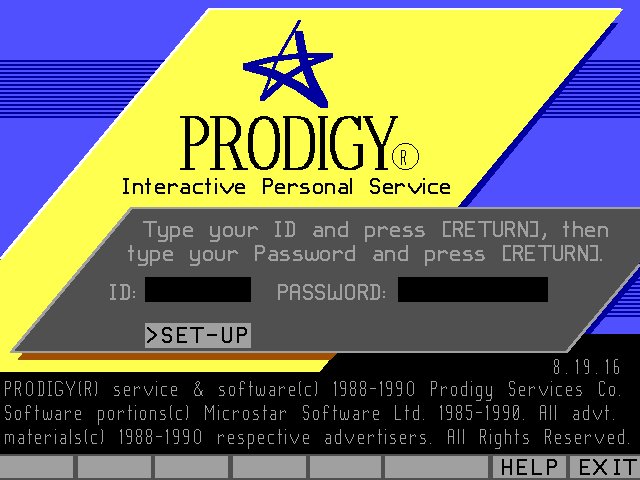
Myspace - the next Prodigy?
Over the last year, there’s been a tremendous amount of focus on the “Widget economy”. Newsweek has even dubbed 2007 as the “Year of the Widget.” While the concept of a “widget” might seem trivial to many outside of Silicon Valley, the ability to automatically embed a rich flash application inside another site is very powerful. It has become a new vehicle for massively gaining viral distribution. One well-known example is Youtube, as their growth was significantly driven by Myspace -- with Myspace quickly becoming Youtube’s largest source of traffic.
And this new opportunity has not gone unnoticed by the VC community. I'd estimate that over $250 million dollars has been invested in widget companies during the last 18 months. And just as every consumer-facing Internet company has developed a strategy to leverage Google (via organic or paid search), they have also developed strategies to “widgitize” a portion of their application for distribution via Myspace. While there are other sites which allow widget embedding, the vast majority of the growth has been on Myspace. In fact, I would argue that until last week, the term “widget” has been synonymous with “embedded Myspace application.”
However, every widget company has been afraid of the uncertain rules of the road for operating on Myspace. Myspace does not have a formal developers program and has blocked several widgets before, built their own widgets to compete in certain areas, making it pretty clear that they don’t view the relationship with the widget ecosystem as symbiotic. Myspace also has a policy against commercial activity in widgets, including placing advertising in a widget – leading some to wonder whether Myspace would ultimately erect a “tollbooth” for the widget providers.
This uncertain playing field provides a high degree of risk for the widget companies and their investors. In fact, I’d think it safe to say that the #1 priority of virtually every widget company has been to “diversify our traffic away from Myspace.” Rather than recognizing the symbiotic nature of their relationship with widget companies (as David Hornik wrote about a few weeks ago), Myspace’s lack of a clear “widget roadmap” created a big opportunity for their #1 competitor, Facebook.
Just last week, Facebook took advantage of that opportunity in a huge way. Specifically, Facebook announced their new development platform, F8. I won’t spend a lot of time describing their announcement (I'll leave that to others), but I agree with Paul Allen’s summary of the three key points:
- Applications can be deeply integrated with Facebook
- Distribution of the applications will occur through the network, and
- The business opportunity Facebook is providing will give 100% of advertising revenue (for third party applications) and 100% of transaction revenue to the application developers.
By providing a clear roadmap – and business opportunity – for the widget makers, Facebook has just increased its virtual R&D budget by over $250 million dollars. By welcoming third-party innovation, Facebook will reap the benefit of hundreds of millions of dollars of venture investment – and the Facebook user will have a much richer experience. I'd wager that every widget maker who has previously relied on Myspace for traffic is hard at work this holiday weekend on migrating their application to support the Facebook API.
Think about it. If you ran a venture-backed company and had to decide whether you wanted to focus your effort on: (a) a property that welcomed you in and let you keep 100% of the revenue you generate or (b) a company with a vague policy that doesn’t let you generate any revenue, which would you choose? I don’t think it’s even a decision. It’s an IQ test.
Facebook has recognized (and embraced) something that Myspace has not – that there is more value in owning a web platform then a web property. This brings back memories from the early days of the Internet, when companies like Prodigy and AOL were the only online services in town. Despite the launch of the web browser (which unleashed the creation of millions of web sites), AOL and Prodigy initially focused on maintaining their proprietary online environment and controlling everything on their site. It took a few years, but ultimately they saw that it is impossible for one company -- no matter how popular and well-funded -- to compete with an unlimited army of motivated (and funded) developers. Even Microsoft recognizes that the true strength of it's Windows platform comes from the volume of third-party developers building (and profiting from selling) Windows applications.
Will Myspace remain a semi-closed web-property? Or will it recognize that the power is in the platform? It wouldn't be hard for Myspace to retake the offensive by offering a clear developers program. All it requires is a realization that everyone benefits from third party investment of capital and creativity in the Myspace platform. The users get far better functionality than Myspace can develop on its own. Myspace would continue to receive hundreds of millions in "free product development". And the widget companies could finally feel secure in their decision to invest in Myspace. It will be interesting to see how this plays out…


Josh
I had honestly forgot what a Prodigy login page looked like. But the minute I saw it on your blog, my account number and password popped into my head. I can still remember connecting to a banking network that I had to pay for through Prodigy that I was paying for.....God Bless the Internet and openness...
Posted by: Ben Smith | May 27, 2007 at 11:17 PM
Very insightful. But even though it's a selfish Gorilla, Myspace is the 800 pound Gorilla in the social network space. Facebook's move is great but it remains to be seen how this will play out and if Myspace will rise to the challenge.
Posted by: Joe Duck | May 28, 2007 at 12:46 AM
txvn66a
Posted by: Charlie | May 28, 2007 at 01:59 AM
Very good points, but I think you'll agree that the discussion would be moot had Yahoo! had the proper vision early on. While there's been a lot of talk about Yahoo buying a social network, (last rumor I saw had Bebo as the target), what will they do with it? Allow it languish as Google has done with Orkut?
If Yahoo's approach in building its network had been to ensure cohesion between all of its various properties, then adding the social aspects would have made them the 8,000,000 pound gorilla. Who would've needed anything else?
Facebook is on the right track. It will be interesting to see if this move will do anything to help them gain traction in pulling in users from MySpace and the wannabes.
Posted by: Chris Rindone | May 28, 2007 at 10:59 AM
great post, altho i'd say the larger question isn't whether MySpace is being dumb and Facebook is being smart, but rather:
* Why the hell aren't Google & Yahoo (& others) making more of an investment in their platforms, and encouraging the growth of a development ecosystem?
Yahoo made some decent attempts a few years ago, but it feels like those have languished.
Similarly, altho Google has been doing a decent job enabling 3rd-party widgets for its personalized homepages (now "iGoogle", nice innovative branding there), they have yet to convince anyone they are planning to promote or evangelize on behalf of 3rd-party developers.
Amazingly, even Microsoft, king of promoting 3rd-party developers for its platforms in the 90's, has similarly done a crappy job here. Perhaps that's due more to lack of market share than lack of effort, but for someone who wrote the playbook on platforms a generation ago, they appear to have forgotten how to make it work on the web.
Amazon & eBay both have done a much better job in the past ten years than almost any of the other platforms... too bad their stories are getting a bit old & tired.
Strange that just as the web is maturing as a platform, all the big platform players are missing a great opportunity to grow.
Kudos to Facebook for realizing early that the key to a rich & growing platform is DEVELOPERS, DEVELOPERS, DEVELOPERS, DEVELOPERS!
- dave mcclure
http://500hats.typepad.com/
Posted by: Dave | May 28, 2007 at 11:03 AM
ps - nice flashback to Prodigy. makes me feel verrrrry old ;)
Posted by: Dave | May 28, 2007 at 11:04 AM
Josh,
I think you're exaggerating the value of any social network as a platform. If Facebook has passed your supposed IQ test, why don't they have email yet? Why is their application integration so awful? Most apps on Facebook are going to have minimal traction and what will happen is that it will end up looking like a cleaner version of Myspace. The "long tail" of apps is going to represent all but the top 10 apps and even those will be annoying for profile viewers.
Widget companies are inherently worthless. Widgets add little value and are easy to replicate. As a VC you need to stop investing in me-three widget companies and figuring out what you can actually do to add value to this world. Making money is important, but shouldn't entrepreneurs solve real problems and meet real needs rather than throwing engineering talent at designing the 200th photo or music sharing widget?
Posted by: Jay (living in First Life) | May 28, 2007 at 02:27 PM
As someone who has lived on both ecosystems, I have to agree that Facebook got it right. I'll gladly take 20m future movers and shakers over 100m of random casual users ranging from the addicts that can't wait for someone to stroke their ego to the untold number of phoney accounts set up for spam bots.
And, with all the respect, Jay, what makes you an oracle? Give the ecosystem some time to play and develop its new DNA ;)
Posted by: Peter | May 28, 2007 at 08:29 PM
i think that what facebook is doing is really smart. but i also wonder if it goes far enough for the widget world - i'll be impressed if they enable users to publish data out of facebook as well as pulling it in.
and i disagree with jay on the value. widgets make data and functionality portable. the data and functionality are just as valuable as they were wherever they came from (assuming that monetization schemes work). and, for many smaller companies, they make the data and functionality _more_ valuable, because they allow them to find an audience.
Posted by: Lucinda | May 28, 2007 at 08:35 PM
great post. Its interesting reading what the VC community discuss about the online communities. From the marketing community we discuss the user experience more and how brands can get involved and differentiate within the experience. I think this recent move from FB shows that the original developers are still involved. Myspace is being run by news int. now and you can see that in their closed business model. As they dont understand the major shifts of the landscape. This type of open source environment is not new as you have discussed but is a major turning point in the way the market will evolve further. Other big old organisations that might buy into this market will need to watch and take note. Very interesting times
Posted by: Mikej | May 30, 2007 at 05:07 AM
"Facebook has recognized (and embraced) something that Myspace has not – that there is more value in owning a web platform then a web property."
exactly right. very insightful post.
i'm not ready to call myspace a dinosaur just yet, but facebook has made a very smart move.
Posted by: hillary | June 05, 2007 at 03:43 PM
Great post
Posted by: Angela | June 27, 2007 at 03:07 PM
Can you please explain how the economics play out?
Let's for a second assume that you invest in an "apps" company that employs 4 engineers and 1 business person (if there's no business person involved, I hope your LPs don't commit any further funds to your firm). Let's assume you low-ball on salaries because the engineers are all co-founders and you get them to work for $40,000/year. Make that fully loaded and you're up to about $60,000/year. For the sake of argument and simplicity, let's assume the business guy comes at the same price so we've got 5 people at $60,000/year fully loaded. That's $300,000/year in H.R. costs. Now add in $100,000 for using Amazon's EC2 and S3 and $50,000 for office and $50,000 for legal. You're up to a $500,000 per year cost structure.
If we are to believe Andrew Chen at Mohr Davidow (http://www.insidefacebook.com/2007/06/24/vc-perspectives-on-the-facebook-platform-andrew-chen-mdv-eir/), we see that Facebook app CPMs should be somewhere around $0.01/CPM.
Now, just to cover the operating costs of the business, we have to hit 50 milion CPMS which is 50 billion views.
Let's say the average app user logs in 300 times per year (I think I'm being quite generous here), then you need 166 million app installs to just cover costs.
Please do enlighten me how your "portfolio apps companies" plan on getting 166 million Facebook users to install the app given Facebook doesn't even have that many members?
Posted by: Jay (living in First Life) | July 10, 2007 at 12:51 PM
yo nice!thanks for your sharing sir!
i will give u some useful websites.
http://www.buywowgold.org.cn wow gold|buy wow gold
http://www.buy-wow-gold.org.cn wow gold|buy wow gold
Posted by: cool dog | October 09, 2007 at 11:37 PM
Social networking is becoming more and more popular by the minute. Some users have dozens of videos embedded into their profiles and myspaces. It wouldn't be a bad idea to take advantage of the situation and turn a profit.
Posted by: trademark registration | November 27, 2007 at 01:24 PM