Redeye VC

Josh Kopelman

Managing Director of First Round Capital.

espite being coastally challenged (currently living in Philadelphia), Josh has been an active entrepreneur and investor in the Internet industry since its commercialization. In 1992, while he was a student at the Wharton School of the University of Pennsylvania, Josh co-founded Infonautics Corporation – an Internet information company. In 1996, Infonautics went public on the NASDAQ stock exchange.

Read more or visit First Round Capital

The Implicit Web

I’ve recently come to the conclusion that Web 2.0 no longer has any unique meaning.  It now means “any Internet-based company that has launched after 2004”. It is as useless a descriptor as “dot com” was.

Jason Calacanis today posted his attempt to define Web 3.0. Like Fred, I sure hope we can find a better name for it than 3.0. I also think that Jason’s proposed definition is incomplete. I believe that a big part of “what comes next” will center around the Implicit Web.  Since the Wikipedia entry on Implicit Web is pretty obtuse/complex, here’s what I mean by implicit web:


As people spend more time online and perform more of their activities online, they create a lot of data about themselves online. Netflix knows what movies I watch and like. Apple knows what music I purchase and listen to. Amazon knows what books I purchase and like. Evite knows what events/parties I’m going to. Tivo knows what TV shows I like. Opentable knows where I like to eat. Fandango knows what movies I go to. Ticketmaster knows what shows I’ve seen.


However, until now that data has existed in silos. There has been no easy way for me (as a user) to access and benefit from that data.  I think the Implicit Web will give users the ability to control the data in these silos and decide who and how it gets shared with.


Let’s take a simple example. If a user joins Facebook
today and wants to complete their personal profile, they get presented with several blank boxes (see right) to fill out. However, via the Implicit Web, as user should be able to tell Facebook to:

  • Fbprofilecheck Apple (or Rhapsody or iLike) for their Favorite Music
  • check Tivo (or Comcast) for their favorite TV shows
  • check Netflix (or Flixster) for their favorite Movies, and to
  • check Half.com (or Amazon) for their favorite Books.

Why should users be forced to re-create data that already exists? Talk about a waste of time.

I think there is a huge opportunity here. In fact, it reminds me of an opportunity I saw in 2000. In 2000, Sony launched their Playstation 2 – and they were quickly sold out. Over 50,000 Playstation 2’s were listed on eBay in the first week. That means that 50,000 sellers had to go to eBay and spend 15+ minutes creating the exact same listing. Every seller had to type-in the same description and upload the same picture. That’s over 12,500 hours wasted re-creating something that already existed elsewhere.  And that helped shape the vision of Half.com.

First Round Capital is actively looking to invest in companies that help make the Implicit Web a reality – either by breaking down the silos or by taking advantage of the data in a new way.

One final story. I remember hearing a story about a research study on dating (I haven’t been able to find the exact study – if anyone knows it, please tell me). Researchers basically arranged two types of blind dates. The first group of blind dates was a traditional dinner – where two people spent two hours talking and getting to know each other. The second group of blind dates was a little different. For this group, they took one person and let them spend five minutes alone in the other person's home or apartment. They could see their fridge, their clothes, their books, their music, how messy/neat the house was, etc.

And they found that the person who spent five minutes collecting implicit data got a far better (and more accurate) picture of their date then the person who spent two hours collecting explicit data by conversing.

I wonder if the same results will hold online…

Silence

So, I know I've been a bit quiet on the blogging front lately.  A combination of a crazy schedule, overflooded inbox and an injury have taken their toll.  I have been making my "list of things to blog about when I have time" -- and I hope to have some time next week, so stay tuned.  In the meanwhile, a few small updates on the last month:


  • Apiconference_2Portfolio company, Mashery, closed their next round of funding from Formative Ventures and Accelerator Group.  Mashery is also currently sponsoring Dealmaker Media's one-day conference, "The Business of APIs".  If your company is doing anything new on the web today, you are probably looking at APIs and Web Services -- and this conference seems like a unique opportunity to learn from several companies who have already launched API distribution programs.

  • Brett Hurt and the Bazaarvoice team also recently announced their most recent round of funding, led by Battery Ventures.  Watching these guys execute has been amazing -- their client list reads like a "who's who" of ecommerce.

  • We also recently led a seed-stage investment in Satisfaction Unlimited.  Satisfaction provides a set of tools that allow companies to crowdsource their support amongst their customers.  They are part online discussion, part FAQ, and part social network. Anyone can ask a question, submit an idea or problem, or just talk.   Love a company?  Hate a company?  Get some Satisfaction here...

  • One of our (west-coast) portfolio companies, is actively (urgently) seeking an IT/Operations person (either full-time or contractor).  They are looking for someone with expertise in (1) running a 99.99% uptime high traffic consumer site, (2) colocation management and bandwidth provisioning, and (3) Linux, Apache, Tomcat, Java and MySQL.  If you know of anyone, please let me know...

  • I broke my shoulder a few weeks ago.  In order to spare myself the "Groundhog's Day" experience of repeating the same conversation 20+ times a day, I decided to put the footage of the injury on Youtube...

Mint.com wins Techcrunch40 Conference!

Minttransparentglossy Congratulations to Aaron Patzer and the entire Mint.com team for their selection as the "best presenting company" at the Techcrunch40 conference.  Given the 40 amazing companies that presented there, this honor is quite an endorsement.  It's been just about one year since we made our initial investment in Mint, and this is quite a way to launch a product!  (If you're interested in a free web-based tool that helps you manage and make money, check out mint.com today)...

I'm also excited that two additional First Round Capital portfolio companies launched at Techcrunch40 to great reviews -- Xobni and Powerset.  Xobni is well on their way towards making Outlook suck less -- check it out here.  And Powerset is working hard towards improving your ability to search the web intelligently.

I can't tell you how bummed I was that I was unable to make the conference due to a prior commitment - but First Round Capital was well represented by Chris and Rob.  I continue to be amazed at the power and scale of the Techcrunch platform that Michael Arrington is building.  Congratulations to Michael, Jason and Heather as well on what sounds like an amazing maiden conference!

Voicestar acquired by Marchex

Congratulations to Ari and Todd on their sale to Marchex (NASDAQ: MCHX). 

I first met the Voicestar guys back in 2005.  They were among the pioneers of the pay-per-call market -- and I recall being amazed by how muVstrlogoch they accomplished with no outside money.  They funded their first year of operations by consulting in their "spare time".  Todd was a coding animal --  writing every line of code in the product by himself.  And Ari was an unbelievably persistent (and persuasive) business development machine -- singlehandedly managing a pipeline of over 100 prospects. 

And in March of 2006 Voicestar raised their first round of outside capital (with First Round Capital ultimately becoming their largest outside investor).  Voicestar has continued to be a model of capital efficiency --  only raising about $1 Million since inception.  And they executed perfectly -- growing nearly 20% month-over-month and signing up over 200 publisher partners (including some major metro newspapers, the yellow pages giant R.H. Donnelley (RHD), and Val-Pak (CEI), the coupon publisher).

As a result of their capital efficiency and limited dilution, the founders were in a position to take advantage of what I previously have called "The New Dual Track."  The fact that a company can exit for $20 million and still be a "win" for both founders and investors is definitely illustrative of some major changes in the startup/venture ecosystem. 

I wish the entire team the best of luck at Marchex -- and hope our paths cross again soon.  Ari and Todd are a class act - two hard-core entrepreneurs who built a real business the hard way.  A bottle of Dom is on the way...
 

Oops...I did it again...

Yahoo closed it's $680M acquisition of Right Media last week.  Another deal on my woulda coulda shoulda list.

-----Original Message-----
From: Noah Goodhart [mailto:?????@?????.com]
Sent: Tuesday, March 08, 2005 10:07 PM
To: Kopelman, Josh

Josh,

As you may remember, we spoke several months back about an investment
in our online advertising network. Since that time, there has been a
very interesting series of events, and there is now a new opportunity.
If you have a few minutes in the next day or so, I would love to be
able to bring you up to date. You can reach me on my cell at
???.???.???? or just let me know what time works for you.

Best,
Noah
 

The .VC Domain

Vc So, I recently came across a website that was from St. Vincent -- and I noticed that it had a .VC domain extension.  And I learned that you can indeed register a .VC domain name.  So, I'm now the proud owner of firstround.vc and redeye.vc.   (I sent an email to the NVCA two months ago, suggesting that they cut a deal with the .VC registrar so every venture firm gets their own domain -- but I didn't hear back.  They're probably too busy trying to keep my tax bill low ;-)

Now if there was only a .startup domain extension, everyone would clearly know what side you're on ;-)

The Unintentional Moonshot - or how a high valuation can "lock your exits"

No_exit_256x_3 Jeremy Liew of Lightspeed Ventures recently blogged about Asymmetric risk and the dangers of too high a valuation.   This is something I've been thinking about for the last several months, as I observed several new trends:


  • Valuations have increased pretty significantly over the last year. 
    Like Jeremy, I have witnessed an increase in valuations over the last year, with most of the increase occurring in Series B or Series C rounds.  This was validated by the most recent Fenwick & West Venture Capital Barometer which showed a 75% average price increase for companies receiving venture capital in 1Q07 compared to such companies’ previous financing round. This was the largest increase since the survey began. 
  • The number of exits has decreased over the last year.
    At the same time that valuations have increased, the number of total exits have decreased.  According to the most recent NVCA Exit Poll, there has been an 18% drop in the number of venture-backed exits for the first half of 2007 when compared to the first half of 2006.  Specifically, there were 188 exits in 1H 2007 (144 M&A exits and 44 IPOs) versus 228 exits in 1H 2006 (199 M&A exits and 29 IPOs). 
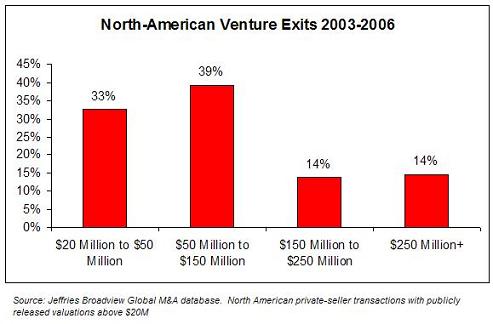
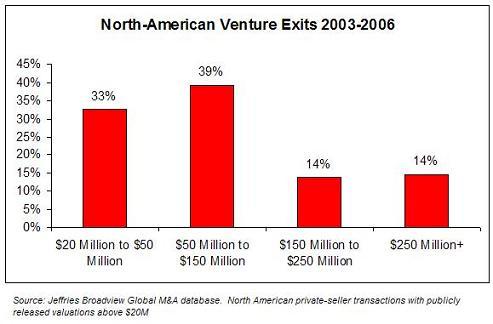
  • An increasing portion of M&A exits are occuring below $150 Million.
    According to the Jeffries Broadview Global M&A database, 72% of Venture-Backed M&A for the past 4 years has been below $150 Million.  Take a look at the chart below.
Exits3

What do these three trends mean?  I believe that under certain circumstances, they argue that that high valuations in a Series B/C round are not always the best thing for entrepreneurs.   Now before you go off saying that as a VC I have a reason to advocate for lower valuations, wait a second.  My firm, First Round Capital, is a seed-stage investor.  As the first money in, our interests tend to be aligned with entrepreneurs -- if the company gets a high valuation for a Series B or C round, both the entrepreneur and my firm experience less dilution.  And if the company takes a lower valuation, we both get diluted.  So we have a pretty good reason to try to maximize valuation.  However, in many cases I think that might be shortsighted.

When a company gets a term sheet with a high valuation, they need to pay attention to the unwritten term on the term sheet.  Specifically, they should make sure they are comfortable with the exit multiple that would generate the returns needed to satisfy their VC.  While every situation is unique, here's a simple rule of thumb:

Series A – 10x
Series B – 4-7X
Series C – 2-4X

So, once you sign a Series B the term sheet valuing your company at a $50M premoney, you’ve basically signed up for at least a $200M exit target.  With the data showing that there are fewer exits -- and those that do exit happen at lower prices -- I think it's worth considering whether you want to eliminate the head-end of the M&A curve (ie, with 72% of all exits occuring below $150M, why force yourself into the “moonshot” trajectory?).   

Now, I’m all for playing to win – and going for the billion dollar outcome.  However, I think there is a concrete financial value to keeping your options open.  As an investor in StumbleUpon and del.icio.us, I can pretty confidently say that had either company elected to raise a Series B round -- it would have been very difficult (if not impossible) for the founders to choose to sell their companies when they did.  And while Jason Calacanis believes that "there is little risk to raising too much money", I respectfully disagree.  Had Jason raised a large venture round at Weblogs, Inc. I doubt he would have been in a position to accept AOL's acquisition offer.

One thing to note, I'm not saying that there aren't times where a company's progress/opportunity is so compelling, that it makes sense to decide to take the asymmetric risk and lock yourself into a big-exit trajectory.  We've definitely participated in several of those deals.  But I am saying that, in my experience, most entrepreneurs aren't making a conscious decision to go for the moonshot.  By optimizing solely for valuation/dilution, they aren't considering the outcomes they are removing from the table, or the added risk they are taking given the changing exit landscape.

As Brad Feld concluded when he commented on Jeremy's post, they key is to "pay attention to the risks of having valuations being both too high and too low, and understand the asymmetries in those risks."

One final note -- I continue to believe what I have said over and over --that "entrepreneurs should focus on building real, long-term value" and "you can't build a company to sell it."  I am not advocating that you build a company with the primary focus to sell it.  What I am saying, is that too many founders are not aware that they are shutting off the majority of exits -- and therefore increasing risks -- when they accept a high valuation.  When people say there is "no risk" to raising a lot of money or getting a high valuation, I think they are not looking at the current exit realities