Redeye VC

Josh Kopelman

Managing Director of First Round Capital.

espite being coastally challenged (currently living in Philadelphia), Josh has been an active entrepreneur and investor in the Internet industry since its commercialization. In 1992, while he was a student at the Wharton School of the University of Pennsylvania, Josh co-founded Infonautics Corporation – an Internet information company. In 1996, Infonautics went public on the NASDAQ stock exchange.

Read more or visit First Round Capital

No voice...

Istock_000002891120xsmall I spent all day yesterday on the phone. 12+ hours of phone conversations – and I went to bed last night with a sore throat. So when I woke up this morning with no voice, I wasn’t completely surprised.

I had two entrepreneur pitches and one board meeting in New York City today – and I felt OK – so I decided to take the meetings. Initially, I was extremely concerned that my laryngitis would dramatically reduce my effectiveness and productivity in the meetings. However, as the day went on, I noticed something interesting. Because it was so difficult for me to talk, it forced me to make every word count. Where I previously might have interjected with a question, now I was writing them down to see if they got answered elsewhere in the presentation. If I wanted to provide feedback or an opinion, I was much more concise than I otherwise would have been. And, I found that my meetings were just as productive/effective as they would have been if I could speak freely.

So what should I learn from this? Well, I guess it shows that I should talk less and listen more (something my wife has been saying for years). And when I do choose to speak, I should conserve my words. It will be interesting to see if I have the discipline to continue this when my voice returns…\

In and Out...

Some portfolio company news today.

Openads First, today we announced our investment in OpenAds, the developer of the leading free, open source adserving platform.  Already used by more than 20,000 publishers across 140 countries in 20 languages, Openads powers more publishers than all competing solutions combined.  What really excites me about OpenAds is that they are in a wonderful position to shrink the adserving market.  By removing the adserving costs, publishers can now focus on raising their effective CPM.  This is especially important for small and mid-sized publishers, who previously had a limited choice of adserving technologies – and no real ability to impact pricing.  I look forward to working with Scott and his team, along with our co-investors (Index Ventures, Mangrove Capital Partners and O'Reilly AlphaTech Ventures) on this deal…

Second, as Techcrunch has reported, Cuts.com has been acquired by Rifftrax.  Although Cuts.com’s product has been praised for its ease of use and fun, the market for a stand-alone video editing site has quickly become very crowded and competitive.   And while this transaction was not the huge win we were playing for, I’m happy that Evan and his team were able to find a home for their business.  As I wrote back in March, the goal of a seed-stage investment is to validate (or disprove) a venture's hypothesis – and successful entrepreneurs will do so using as little time and capital as possible.  Evan Krauss and his Cuts.com team did just that. 

Some website upgrades...

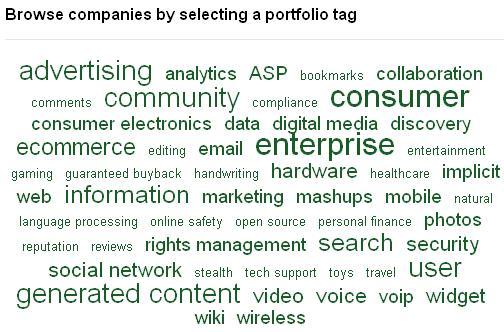
As First Round Capital's portfolio has grown over the last few years, our firm's website has not grown with it.  That's why we recently decided that an overhaul of our website was necessary. So, in addition to the traditional alphabetical listing of portfolio companies, we decided to try something new. To help people better navigate our portfolio, we recently launched a tag cloud. This provides an interesting perspective on where we’ve concentrated our investments. We also improved the portfolio company detail pages – providing both company news and job openings…

Port_3

In addition, we also just launched an experiment. For the last several weeks, I have been an active member of Ycombinator’s Startup News site. Like Digg, their site allows any member of their community to submit news items – with the best rising to the top. At First Round Capital, my partners and I have historically shared news stories using a common del.icio.us tag. Inspired by Ycombinator’s site, we’ve decided to experiment with allowing members of our community to submit stories on our site as well. I invite you to visit http://news.firstround.com to submit, share, and vote on stories and websites.  We look forward to seeing the stories you find interesting.

Finally, I just wanted to thank my partner, Rob Hayes, and our west-coast office manager, Carly Spoljaric, for organizing a wonderful cocktail party last week. Pictures of the party available here.

www.flickr.com
This is a Flickr badge showing public photos from Flickr tagged with firstroundcapital. Make your own badge here.

Everything old is new again...

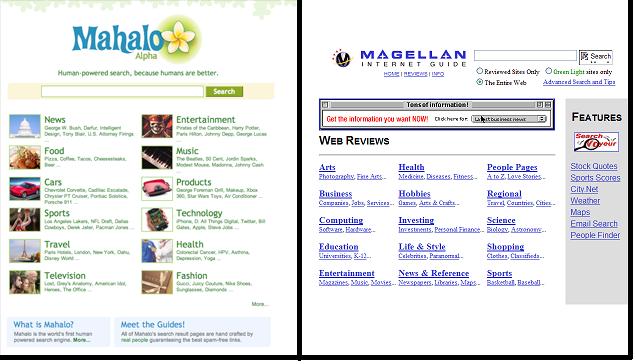
I'm at the WSJ D Conference this week, and just saw Jason Calacanis launch Mahalo.com.   Mahalo is intended to be a "human powered" search engine.  Apparently, the top 20,000 queries to Google represent almost a third of all their traffic -- and with the rise in SEO and search-engine spam, many of the top results are of little value to their users.  Mahalo believes that humans can help make search results better and has hired 40 human editors to hand-craft the results pages for the top queries.  They've done 4,000 pages to date and hope to have 10,000 pages by year-end.  A big, bold bet.

It also sounds similar to the old McKinely Magellan Internet Guide of 1995 (see Internet Archive's copy of the site here).   From an old Magellan press release:

Magellan is the product of a marriage between McKinley's proprietary search technology and its unique editorial process. Sites in the Magellan guide are reviewed and rated by a highly informed editorial staff, with expertise in topical areas. The resulting site evaluations not only provide users with in-depth information, but also a human voice.

Mahalo_2

Hopefully Jason's bet will turn out better than Magellan's did.

More on Mahalo available on Techcrunch and Webware.

Bunch of stuff today...

  • Congrats to Garrett, Justin, Geoff, David and the rest of the StumbleUpon team on their sale to eBay.  (A bottle of Dom is on it's way).  I've thoroughly enjoyed my association and involvement with the company - and look forward to seeing how eBay harnesses the power of StumbleUpon's discovery engine.  They guys blog about the sale here, Michael Arrington and Om Malik share their thoughts here and here.  I'd like to thank fellow StumbleUpon board member Ariel Poler, Brad O'Neill, and Ted Wang for their hands-on involvement - the company could not have had better advisors...
  • Congratulations to my friend Jeff Jordan on his new role at OpenTable.  This is a big win for OpenTable.  In addition to being a great guy, Jeff is one of the smartest, execution-focused executives I know.  I reported to Jeff for two years after eBay purchased Half.com -- and I learned an unbelievable amount from him.  While I was a big fan (and user) of OpenTable before, I'm an even bigger fan now.  Congrats to both Jeff and OpenTable!
  • I really enjoyed Mashery CEO, Oren Michels, blog post on Sixth Sense Companies describing companies that "are already dead, but they just don't know it yet."  I thought it was dead on. 

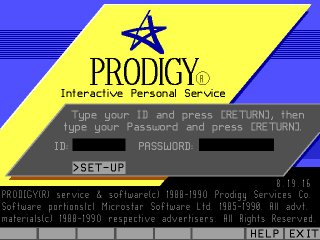
Myspace - the next Prodigy?

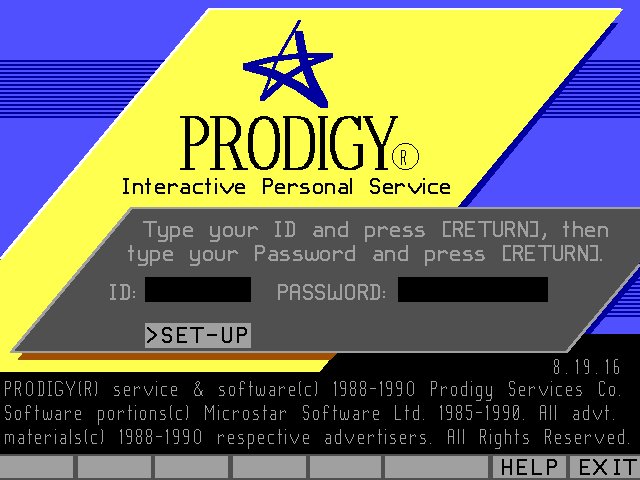
Prodigy_login_largeOver the last year, there’s been a tremendous amount of focus on the “Widget economy”.  Newsweek has even dubbed 2007 as the “Year of the Widget.”    While the concept of a “widget” might seem trivial to many outside of Silicon Valley, the ability to automatically embed a rich flash application inside another site is very powerful.  It has become a new vehicle for massively gaining viral distribution.  One well-known example is Youtube, as their growth was significantly driven by Myspace  -- with Myspace quickly becoming Youtube’s largest source of traffic.   

And this new opportunity has not gone unnoticed by the VC community.  I'd estimate that over $250 million dollars has been invested in widget companies during the last 18 months.  And just as every consumer-facing Internet company has developed a strategy to leverage Google (via organic or paid search), they have also developed strategies to “widgitize” a portion of their application for distribution via Myspace.  While there are other sites which allow widget embedding, the vast majority of the growth has been on Myspace.  In fact, I would argue that until last week, the term “widget” has been synonymous with “embedded Myspace application.”   

However, every widget company has been afraid of the uncertain rules of the road for operating on Myspace.  Myspace does not have a formal developers program and has blocked several widgets before, built their own widgets to compete in certain areas,  making it pretty clear that they don’t view the relationship with the widget ecosystem as symbiotic.   Myspace also has a policy against commercial activity in widgets, including placing advertising in a widget – leading some to wonder whether Myspace would ultimately erect a “tollbooth” for the widget providers.

This uncertain playing field provides a high degree of risk for the widget companies and their investors.  In fact, I’d think it safe to say that the #1 priority of virtually every widget company has been to “diversify our traffic away from Myspace.”  Rather than recognizing the symbiotic nature of their relationship with widget companies (as David Hornik wrote about a few weeks ago), Myspace’s lack of a clear “widget roadmap” created a big opportunity for their #1 competitor, Facebook.

Just last week, Facebook took advantage of that opportunity in  a huge way.  Specifically, Facebook announced their new development platform, F8.  I won’t spend a lot of time describing their announcement (I'll leave that to others), but I agree with Paul Allen’s summary of the three key points:

  • Applications can be deeply integrated with Facebook
  • Distribution of the applications will occur through the network, and
  • The business opportunity Facebook is providing will give 100% of advertising revenue (for third party applications) and 100% of transaction revenue to the application developers.

By providing a clear roadmap – and business opportunity – for the widget makers, Facebook has just increased its virtual R&D budget by over $250 million dollars.  By welcoming third-party innovation, Facebook will reap the benefit of hundreds of millions of dollars of venture investment – and the Facebook user will have a much richer experience.  I'd wager that every widget maker who has previously relied on Myspace for traffic is hard at work this holiday weekend on migrating their application to support the Facebook API. 

Think about it.  If you ran a venture-backed company and had to decide whether you wanted to focus your effort on:  (a) a property that welcomed you in and let you keep 100% of the revenue you generate or (b) a company with a vague policy that doesn’t let you generate any revenue, which would you choose?  I don’t think it’s even a decision.  It’s an IQ test.

Facebook has recognized (and embraced) something that Myspace has not – that there is more value in owning a web platform then a web property.  This brings back memories from the early days of the Internet, when companies like Prodigy and AOL were the only online services in town.   Despite the launch of the web browser (which unleashed the creation of millions of web sites), AOL and Prodigy initially focused on maintaining their proprietary online environment and controlling everything on their site.  It took a few years, but ultimately they saw that it is impossible for one company -- no matter how popular and well-funded -- to compete with an unlimited army of motivated (and funded) developers.  Even Microsoft recognizes that the true strength of it's Windows platform comes from the volume of third-party developers building (and profiting from selling) Windows applications.    

Will Myspace remain a semi-closed web-property?  Or will it recognize that the power is in the platform?  It wouldn't be hard for Myspace to retake the offensive by offering a clear developers program.  All it requires is a realization that everyone benefits from third party investment of capital and creativity in the Myspace platform.  The users get far better functionality than Myspace can develop on its own.  Myspace would continue to receive hundreds of millions in "free product development".  And the widget companies could finally feel secure in their decision to invest in Myspace.  It will be interesting to see how this plays out…

Removing friction from the travel market...

So this post fits more under the "Redeye" category than "VC" category.  However, I recently came across two web-based travel services that I wanted to share.  Both of these services do a great job at removing friction from the travel marketplace...

The first is a company called BoardFirst.com.  They do one simple thing and do it well.  Namely, they guarantee you an "A group" boarding pass for Southwest Airlines.  If you've ever flown Southwest, you know that they don't have assigned seats.  Instead, they board passengers by groups based on when they printed their boarding pass.  This result has been that most sophisticated travellers now wait at their computer exactly 24 hours before their flight to beat the crowd for an "A group" boarding pass.  With BoardFirst, you simply give them your flight information, and they will take care of this for you for a small charge.  The difference between an aisle seat on an emergency exit row and a middle seat in the back of the plane is well worth the $5 charge.

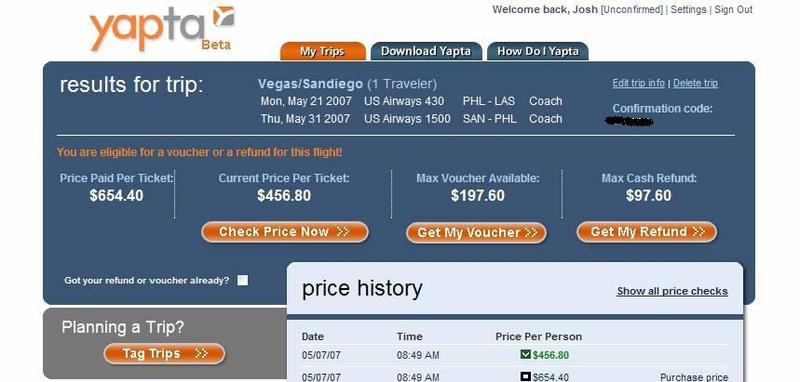
The other service just launched from beta today and is from Yapta.com.   As someone who books travel months in advance, its as if this service was made for me!   I never realized it, but most major airlines will give you a refund if they reduce the price after you have bought a ticket.  So if the price on your ticket drops by $372, you are entitled to a voucher for $372 for a future trip.  So Yapta helps you by tracking fares (both before and) after you buy a ticket.  For example, I'm writing this post from a hotel room in Vegas on my way to San Diego for the WSJ D Conference.  And by using Yapta, I was able to learn that the fare for my ticket changed 19 times during a 13 day period.  And because they lowered the price after I booked my ticket, I was entitled to receive a voucher from US Airways for $197.60-- effectively reducing my fare by 30%.  It will be interesting to see how the airlines respond.  At first I thought the airlines would hate this, but then I realized that if it (a) gave people the confidence to book a seat early, and (b) increased repeat purchases through the use of vouchers, it could be a net positive for the airline industry.  There is some good coverage of Yapta in today's Wall Street Journal and Techcrunch.

Yapta_4  


I love how the web is removing friction and increasing our productivity in the travel space.