Redeye VC

Josh Kopelman

Managing Director of First Round Capital.

espite being coastally challenged (currently living in Philadelphia), Josh has been an active entrepreneur and investor in the Internet industry since its commercialization. In 1992, while he was a student at the Wharton School of the University of Pennsylvania, Josh co-founded Infonautics Corporation – an Internet information company. In 1996, Infonautics went public on the NASDAQ stock exchange.

Read more or visit First Round Capital

Thoughts on seed stage

It was nice to wake up to today to Fred Wilson's blog post - he articulately summarized several of the benefits of investing at the Seed Stage.  His three points (the optionality of being able to see more cards before you double down your bet, the ability to have an impact on the success of the venture, and avoiding being surprised by past decisions) are ones we think of often at First Round Capital.


Failing Cheaper

Failure Ask most successful entrepreneurs how they came up with the idea for their business, and you'd likely learn that what they initially set out to do is very different from the company that you're familiar with. PayPal started out as a service to beam money through Palm Pilots, while YouTube was originally a video dating site. The truth is that early stage ventures are all about experimentation and iteration. As soon as it's written, every business plan is wrong. Good entrepreneurs recognize this, and tend to build agile teams that can quickly respond to early market information in order to identify a real business model and minimize risk.

A necessary side effect of all this experimentation is that most startups will ultimately fail.  While the mythical "90% failure rate" has been disproven, I would venture to guess that for technology based startups the failure rate is still extremely high.  That's just the nature of the early stage venture world, and ideally it allows the entrepreneurs involved to apply their hard-earned lessons towards more productive ventures.  Or, as Jeremy Liew aptly put it: "Companies die, founders and employees learn from the experience and move on, and hopefully start more companies. I for one would love to see the second acts from the teams that are newly freed up."

Today, thanks to a well-documented shift in the online landscape (decreasing storage costs, open-source software, offshore development) it costs much less to start a software-based company than it ever did. Indeed, when I co-founded Infonautics (in 1991) we spent $5M to get our first product to market.  At Half.com (1999) we spent $2.5M to get our first product to market.  At TurnTide (2003) we spent $750K to get our first product to market.  And at Jingle Networks (2005) we spent $300K to get our first product to market.  And, in fact, of the 30+ investments First Round Capital has made over the last few years, our average initial investment size is $300K.

Recently we've been seeing a lot of attention paid to startup failures. Techcrunch has even established a “deadpool ” – reminiscent of the old Fucked Company website during the first web boom. This has led some people to speculate that the increased rate of failure is proof that the current funding model is flawed. I disagree.

Although the aggregate number of failures may seem higher (due to the increased number of companies being launched) the ratio of early stage failures to successes is probably still the same. What has changed is that you can now fail faster and cheaper than ever before. While I'd much rather invest in a company that succeeds, if a company is going to ultimately fail I'd rather it fail quickly. 

I believe that the goal of seed funding is to validate (or disprove) an entrepreneur’s hypothesis, and thereby “de-risk” the opportunity. Early stage companies should raise enough money to allow them to iterate - as long as their initial hypothesis is still valid and they are making demonstrable progress towards lowering risk. Today’s model of failure is far more capital efficient in allowing entrepreneurs and their investors to do this than the old model. Companies used to waste millions of dollars of VC money – and entrepreneurs used to waste years of their lives – working on a failed hypothesis.  Now, the cycle is much shorter.

At Infonautics back in 1991, we raised seed capital to conduct market research – we spent about $150K in surveys, focus groups and secondary research to validate our market.  Today, companies can actually launch a product for that amount, in a much shorter period of time.  What would you rather see, the results of real market feedback, or the results of market research?

The following graphs (courtesy of Benchmark's Peter Fenton via Venturebeat) illustrate what he describes as the "increasingly Darwinian environment for Internet companies":


Traditional Funding Model


In the traditional funding model a company's risk was decreased by hitting certain milestones, which brought about a corresponding jump in its valuation. Additional funding was needed at each milestone, resulting in a high overall level of financial investment by the investors, and time investment by the entrepreneurs.


New "Cheaper" Funding Model


In the new funding model a startup is able experiment/iterate over an extended period of time for very little capital. Only once some of the venture's risk has been eliminated through accelerating adoption does the company raise more money to further refine the model and expand. Overall the time and cost between the founding of the company and knowing whether both the entrepeneurs and investors should continue to pursue the opportunity is greatly decreased.

I expect that as a seed-stage investor, I will have a much higher number of failed investments than later-stage investors.  However, I also expect that I will invest less total capital in failed ventures.  Will I be proven right?  Only time will tell. For now though, I’d much rather back companies that are able to fail (or succeed!) cheaper.

Thanks to Mazen Araabi for helping with this post...

The Penny Gap

Lincolnmemorialpennyreverse120_1Updated - See bottom of post

Here at First Round Capital, we see a lot of business plans for consumer-facing internet services. Most assume a significant portion of their revenue comes through advertising -- but almost all of them have a "premium/subscription" option.  Typically that subscription revenue accounts for 20-40% of total revenue, and is based on a very low ($1-5/month) subscription fee.  When asked to support these subscription revenues, entrepreneurs almost always say "well, it's very cheap ($2 a month) and we're only assuming 5% of our users take advantage of it)."  On the surface, a reasonable position. 

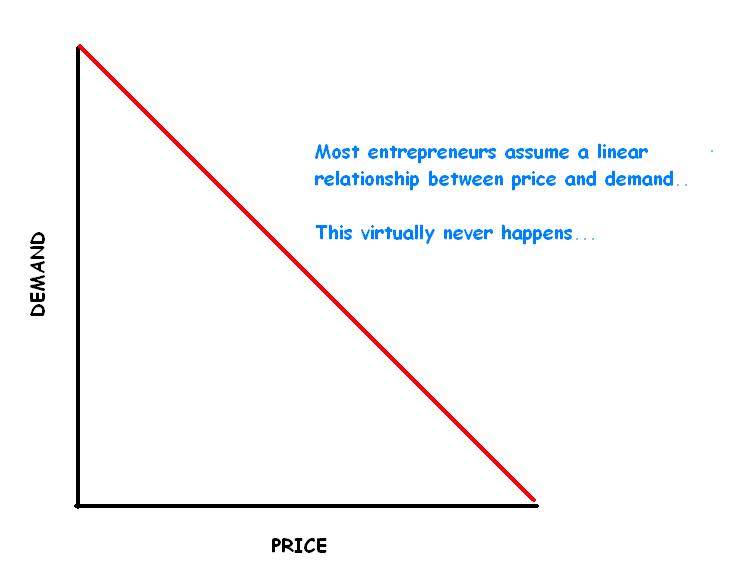
However, that is rarely how things play out.  Most entrepreneurs fall into the trap of assuming that there is a consistent elasticity in price - that is, the lower the price of what you're selling, the higher the demand will be. So you end up with hockey stick looking revenue charts that go up and to the right, all supported by an "it only costs $2  month" business plan.
Wrong_1

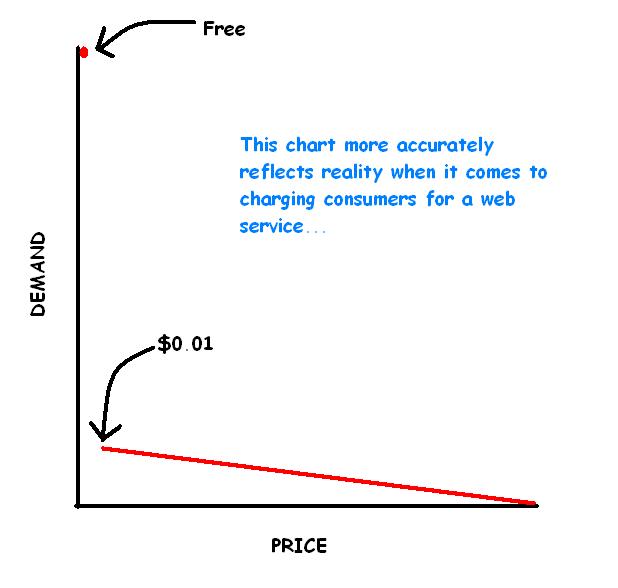
The truth is, scaling from $5 to $50 million is not the toughest part of a new venture - it's getting your users to pay you anything at all. The biggest gap in any venture is that between a service that is free and one that costs a penny.   I can't think of a single premium service that has achieved truly viral distribution.  Can you?
Right

Consider the pay-per-download music sites of the late '90s. None came even close to matching the widespread popularity of Napster or Kazaa. By 2000, Napster was estimated to have 40 million registered users, with as much as 80% of external network traffic on colleges consisting of MP3 file transfers. Kazaa has had almost 400 million downloads of its client to date. Assuming 2 downloads per user that means around 20% of all Internet users have downloaded Kazaa. And the same phenomoenom is occuring now with movies via Bit Torrent  -- as opposed to CinemaNow or MovieLink.  That's the power of free.

At some point, the cost to acquire a paying customer is so high, it makes sense to consider shifting from a pay model to a free model. In these cases, asking “who would pay to reach these consumers” (or "who can subsidize these users) creates an opportunity to build a more valuable business through the combination of exponential growth and targeted advertising. This is what we're seeing today with Jingle Networks, owners of 1-800-FREE411. By harnessing the power of free 411 calls, Jingle has already managed to capture around 5% of the overall 411 market.  And it's interesting to note that "cheaper" directory assistence services such as Easy411 and 4114Cheap existed for years before Jingle was conceived and have gone nowhere.

It happened in music.  It happened in movies.  And it's happening in directory assitance. Now I’m looking for other industries that are going to be converted. If you've got a plan that uses the free model to get that first penny and disrupt an industry, I'd love to hear about it. It’s a great way to shrink a market.

Update:  There have been a lot of wonderful comments/discussion about this post and I wanted to be sure I was clear on one point.  I am not advocating the death of premium services.  Nor am I stating that "free" is the penultimate business model.  Rather, my primary point was to state that many people (mistakenly) believe that getting a consumer to go from "free" to $1/month is just as difficult as getting someone to go from $1 to $2/month.  I think that there is a huge burden to getting a consumer to pay anything -- and entrepreneurs tend to underestimate the level of effort.  If you can deliver enough value to charge for your service -- and cost-effectively attract a large base of paying customers -- of course you should.  However, if you find that you are able to attract a large pool of free users, but can't convince enough of them to pay you -- perhaps you should look at other ways of extracting value.  GigaOm said it best

To be fair to these VCs, they’re not advocating doing everything without pay. They’re suggesting free as a tactic towards getting paid in other ways: through advertising, or by premium services (as in a freemium model), or maybe even through being acquired by a company with a large wallet. Free is only a tactic, though, not a business model.

Conflating the two misleads web application developers into thinking they don’t need to do the hard work of figuring out what’s really of value to users before they build and launch their online service.

Too long...

Yes, this blog is still alive.  I’ve gotten several emails over the last few weeks commenting on the slow pace of my blog posts.  The last few weeks have been pretty busy and the blog suffered as a result.  But I’m now working on several new posts that should begin to appear over the next few days.  In the meanwhile, a few small items:

  • Now that First Round Capital has over 30+ companies in our portfolio, one of my goals for the new year is to help make stronger connections between our portfolio companies.  Most early-stage companies share similar challenges (recruiting, business development, customer acquisition) and I think that there is a real benefit to sharing best practices.  That was the thinking behind the  First Round Capital CEO Summit – which we held last month in Menlo Park.  It seems that the feedback from the attendees was very positive and we're looking to make this an annual event.   I'd like to  thank the CEO’s of our portfolio companies for their active participation, as well as our guest speakers including Michael Arrington (Techcrunch), David Rose (the Pitch Coach), Greg Mrva and Bradley Horowitz (Yahoo), Jorge Espinel (AOL), Heather Harde and Adam Bain (Fox Interactive) and Chris Sacca (Google) and a few of our friends from other venture firms.   Also - major thanks to Rob Hayes and Carly Spoljaric on the First Round Capital team for putting the day together.  Pictures can be found here.

www.flickr.com
This is a Flickr badge showing public photos from Flickr tagged with ceosummit. Make your own badge here.
  • I just finished reading Safa Rashtchy’s massive report on Internet Advertising.  It’s over 400 pages and full of stats…one of the best reports on the space that I’ve seen – and it’s free.  It is around 6MB and you can download it here (Warning - pdf file takes a while to load).
  • I wanted to join Rob Hayes in welcoming aboard First Round Capital's first Analyst, Mazen Araabi.   Maz has a strong entrepreneurial background, with stints at Xdrive.com, ResponseBase, and ReachLogic.  He also already has his first woulda coulda shoulda -- he was part of the founding team at MySpace.com, but left in 2004 to get his MBA.  Welcome aboard Maz!

Friendly competition?

Techcrunch20cWhen Mike Arrington of Techcrunch announced his new Techcrunch20 conference yesterday, I was both excited and disappointed.

I was excited because I think that “launch platform” conferences are a great idea.  They provide a bright spotlight on new companies, technologies and products – and generate meaningful visability amongst press, analysts and investors.  I was excited because I think that having more opportunities to view great companies is better than having fewer.  And I was happy for Mike Arrington, who has really turned Techcrunch into a meaningful brand.  This promises to become a must-see event that I can’t wait to attend.

I was disappointed, however, by Mike’s not-so-veiled attacks on the DEMO Conference.  Rather than taking the high-road (and creating the same sense of “friendly competition” and “mutual respect” that he seems to have done with GigaOm and other competitors in the blog space) Mike choose to attack their integrity and value.  And while some might consider the timing of his announcement great marketing, I think it was bad form.

I think DEMO is a wonderful venue – that provides meaningful value to companies, press and investors.  That’s why First Round Capital has been a partner/sponsor with DEMO for the last several years.  In fact, during the last 8 years, I have either helped to found (Half.com, Turntide) or fund (Aggregate Knowledge, Jingle Networks, Riya, Krugle, VideoEgg) almost 20 companies that have launched at DEMO.  I think DEMO provides a ton of value to its demonstrators. 

Does DEMO charge a fee for presenters?  Yes they do.  However, that fee is equal to one or two months cost for a decent PR firm – and I’d like to see that PR firm get you an audience with almost 50 key reporters (from the WSJ, the NY Times, Businessweek, the Associated Press, etc) and dozens of venture capitalists.  And I’ve seen firsthand how DEMO helps companies that can’t afford it – either by making introductions to funding sources or by providing lenient payment terms.  I’ve known Chris Shipley (Demo’s Producer) for years – and she has worked hard to build a well-deserved reputation for integrity, intelligence and humility.  The way she responded to Mike’s announcement is illustrative of her class and style.

I’m a huge fan of both Mike Arrington and Chris Shipley – and I’m fortunate to count them both as friends.  I think they both have built great personal brands.  I think they both offer extremely insightful thoughts on the technology startup scene.  And I look forward to attending both of their conferences…

I wonder...

D4imgbc23 I just read my partner Howard's post on his wonderful experience with Lenovo.  I wonder what would've happened if he brought them his power cord and asked to borrow a laptop?

Two Dom, Two to Go

W607_c So, we're nine days into the new year and I've already sent out two bottles of Dom

The first bottle was sent to Scott Weiss.  I first met Scott in December of 2000 -- and quickly became convinced that he and Scott Banister had a compelling vision for an industrial-strength email appliance.  I invested in their company (which was called Godspeed Networks at the time) in January of 2001.  (That was before I had founded First Round Capital, so my investment was made personally through Midas Capital).  Godpseed Networks ultimately changed it's name to IronPort -- and six years later, I was thrilled to see that they were acquired by Cisco last week.  Congratulations to Scott & Scott and the entire IronPort team.  Their laserlike focus on messaging security helped define an industry. 

The second bottle is being sent to Scott Rafer.  I got to know Scott when he was CEO of Feedster - another company I invested in (through Midas Capital).  After Scott left Feedster, he and I held several conversations about key themes/areas of interest - and I remember discussing a concept for a persistent social network.  A few weeks later Scott called me back and told me he found a company (via LinkedIn - another Midas Capital investment) that did exactly what we were talking about.  It was a company called MyBlogLog.  I have to admit it -- I didn't see it.  They looked like yet another website statistics tracking company to me.  Scott asked me to invest (at a ridiculously low valuation) and I passed.  It wasn't until the Web 2.0 Conference (where I watched Rafer sell the company to Yahoo in my room) that I realized that I goofed -- but by then it was too late.  So here I am eight months later - adding another company to my "Woulda Coulda Shoulda" list and congratulating Scott, Eric and the MyBlogLog team on their acquisition by Yahoo.  It's a wonderful story - and it couldn't have happened to a more deserving team.  If I can't be “Da Investor”, at least I got to be “Da Konnector”.