Redeye VC

Josh Kopelman

Managing Director of First Round Capital.

espite being coastally challenged (currently living in Philadelphia), Josh has been an active entrepreneur and investor in the Internet industry since its commercialization. In 1992, while he was a student at the Wharton School of the University of Pennsylvania, Josh co-founded Infonautics Corporation – an Internet information company. In 1996, Infonautics went public on the NASDAQ stock exchange.

Read more or visit First Round Capital

Newest Venture Blogger

My friend Jeremy Liew at Lightspeed Venture Partners has finally started to blog.  And he's off to a great start.  I think his 2007 Consumer Internet Predictions are right on the money. 


I look forward to hearing more from him...

Rome for a day?

Dividendmiles3linegbAs another year winds to a close, the end of December is a good time to take a look back at the past year, set goals for the new year, and try to predict what new trends will shape the emerging technology landscape.

For this Redeye VC, the end of December also is the time of year when I check my US Airways miles account.  As a coastally challenged VC, I make a lot of trips to the west coast -- typically between 15 and 20 trips a year -- and US Airways basically owns the Philadelphia airport.  Normally I don't have any problems getting the 100,000 flight miles needed to make Chairman's Preferred.  I've been Chairman's Preferred for the last four years and it has become critical to me -- it basically guarantees me a first class upgrade, it guarantees me a seat on any US Airways flight, etc. 

But during the year I tried something new -- rather than paying full fare for several of my trips to CA, I used miles to get five roundtrip tickets.  And when I opened up my online statement last week, I saw that I only had 86,500 Preferred miles.  I was 13,500 miles short! 

After calling US Airways, they confirmed that you can't buy preferred miles -- you only get them from flying.  So I spent some time on the web trying to figure out how I could get 13,500 miles in a week.  And there was only one non-stop option that would give me enough miles --  Fly to Rome.  If I flew First Class from Philadelphia to Rome, I would get 13,800 Preferred miles.  I would leave December 29th at 8pm -- arrive in Rome around 8am -- eat a pizza at the Rome airport -- leave around noon, and return home by 3pm on December 30th.   Faster than most of my trips to New York.

I spent most of the night trying to figure out how I was going to explain to my wife that I was going to spend $4K to fly to Rome for two hours during our holiday vacation...and didn't come up with a good answer.  That's when I discovered the "Everything Counts" promotion on the US Airways site.  Basically, a few merchants were giving Preferred Miles credits for all purchases through the end of the year.  And FTD.com (the online flower guys) had a special offer -- earn 20 miles for every dollar you spend.  That meant I just needed to spend $675 on flowers over a three day period - or about 20 orders of flowers.  Other than sending some to my wife/family, I didn't know who to send them too.  I thought of opening the obituary section of the paper and sending some to strangers.  Or to sending them to James Brown or Gerald Ford.  But it felt odd to me.

That's when I found the Champagne Holiday Toast -- "a bottle of the most renowned champagne in the world, Dom Perignon, paired with chocolates..."   At $179, I would only need to order four bottles -- and they would last a lot longer than flowers.  So I started to buy them online -- when I learned that they won't deliver alcohol to Pennsylvania.  Or New York.  Or Connecticut.  Or New Jersey.  Finally I decided to ship the champagne to our west coast office, care of Rob Hayes

So I now have four bottles of Dom waiting to celebrate our fund's next exit.  And I made Chairman's Preferred.  And I didn't have to go to Rome for lunch.  A good conclusion to a good year!

Happy 2007 Everyone!

Now that's a holiday card...

I just saw Blueprint Ventures 2006 holiday card -- and fell out of my chair laughing.  It's available on YouTube -- so enjoy.  And Happy Holidays...

Deja vu

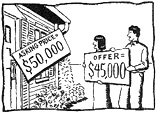
Asking2 I've been watching with amusement the blogosphere's reaction to Zillow's recent announcement of their new "Make Me Move" feature.  According to their press release:

"...any homeowner can now post a Make Me Move price...A homeowner can easily post a Make Me Move price without exposing any personal information. Zillow then enables interested buyers to contact the owner through an email "anonymizer."


Several bloggers who I respect have given positive feedback on the concept, calling it "a big play that could completely disrupt the real estate industry" or "They are finally bringing disruption possibilities to an ancient industry".  And the fact that Benchmark and other VC's thought enough of the concept to invest $57 million is quite an endorsement.

While "Make Me Move" may well be disruptive, what I do know is that I've seen this disruption before. 

Back at the DEMO Conference in 2000 (where I launched Half.com), I remember seeing Bill Gross launch a similar website called MakeAnOffer.com.  As the Washington Post wrote at the time:

"Idealab founder Bill Gross floated a big one with his latest Web business: MakeAnOffer.com, a real estate site centered on homes that aren't for sale. Go ahead, Gross said, make an offer "and we will communicate your offer to the homeowner anonymously.""


What's amazing to me is that the concept is getting rave reviews now, despite the fact that back in 2000 Bill's idea didn't get a good response.  In fact, as ComputerWorld reported back then, "Makeanoffer.com drew laughs, and not in a good way."  From what I can recall, Makeanoffer.com never got traction and appears to have been quickly shut down.

So why the positive response now for an idea that previously failed?  One can either interpret this as (a) an idea that was ahead of it's time, or (b) justification for Om Malik's concept of "Old Bad Ideas 2.0"

Which one is it?  I don't know.  I do know that this would not be the first time that Bill Gross has come up with an innovation ahead of it's time -- after all, he invented the pay-per-click advertising model that was ultimately made popular by Google (which was the subject of a wonderful chapter of John Batelle's book, "The Search").

Either way, it makes me want to explore any other "laughable" Bill Gross ideas that didn't get traction in Web 1.0

We're hiring...

First Round Capital is looking for a (west-coast based) Venture Analyst to help us build and manage our growing portfolio of companies.  More information available here...

Google - The next vertical search engine?

Since First Round Capital has a few vertical search engines in our portfolio (Krugle - a search engine for developers; and Biggerboat - a search engine for entertainment), I've been spending a lot of time recently trying to understand the vertical search space. 

What I've been most interested in, however, is Google's approach towards vertical search.  While a lot of attention has been focused on the recently launched Google Co-op -- which allows Google users to create a search engine for a customized collection of content -- I think that not enough attention has been focused on their OneBox feature.  I think Google OneBox is a pretty decent attempt to create vertical search functionality inside of Google web search.

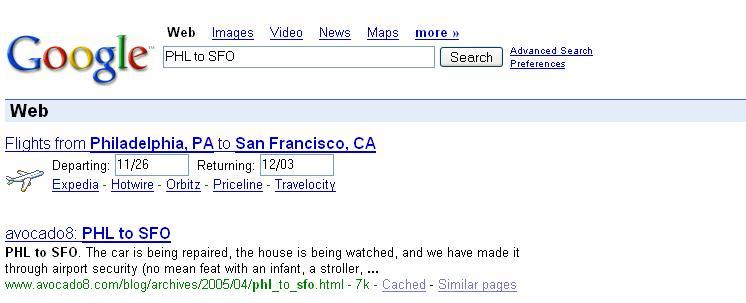
If you're looking to book travel, you could go to vertical search engine like Kayak.com -- or you could just enter "PHL to SFO" in Google and you get a travel OneBox on top of your search results.
1_1


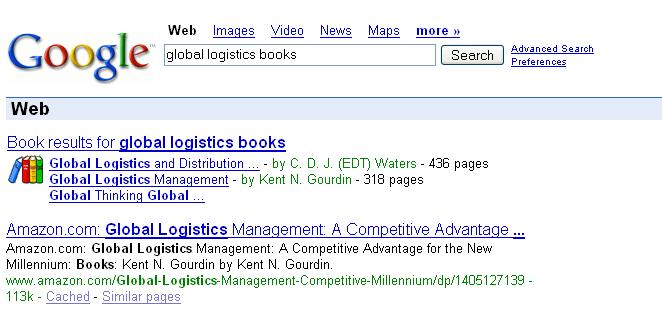
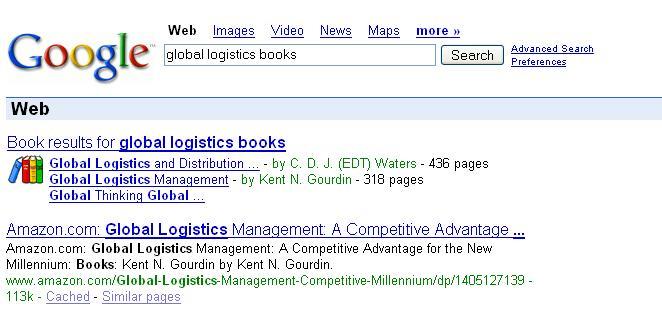
If you're looking to read books on global logistics, you could go to Amazon or Half.com -- or you could just enter "global logistics books" into Google and you get a book OneBox which lets you read the actual content from several books that discuss it.
2global


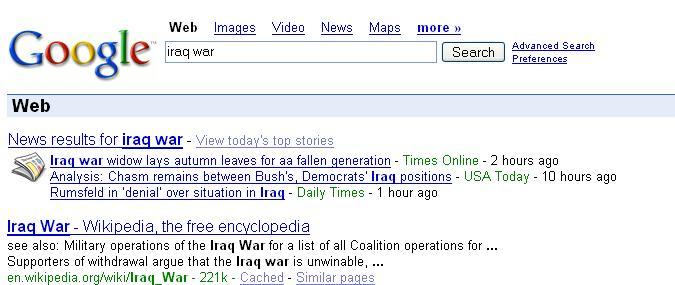
Looking for news on the Iraq War?  You could go to a news site or news search engine -- or you could just enter "Iraq War" into Google and get their top headlines.
3news


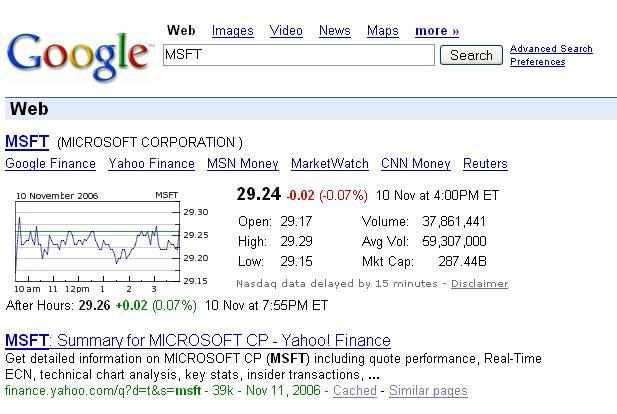
Looking to research a stock (say Microsoft)?  You could go to a financial search site like Hoovers or Quicken to get some info -- or you could enter MSFT into Google and get their finance OneBox.
4msft


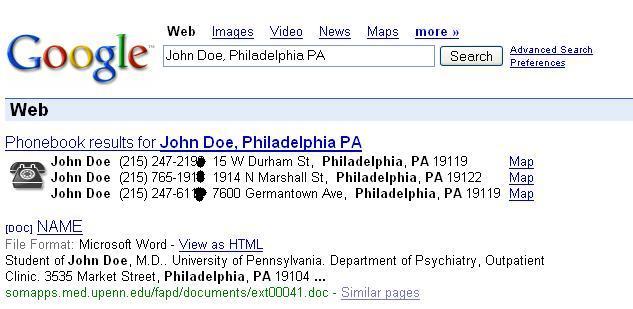
Looking for a person?  You could go to Switchboard, ZoomInfo or LinkedIn to do a person search.  Or you could just type in someone's name and city in Google and get their phone number and even a map to their home.
5johndoe


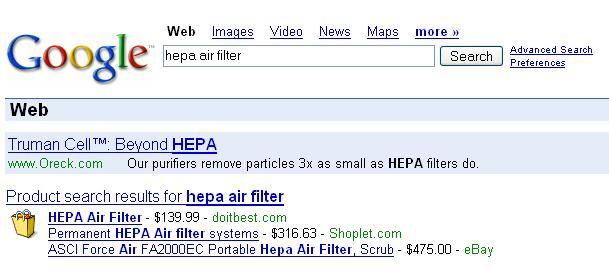
Shopping for a product online?  You could go to a price comparison engine like Shopping.com or Shopzilla -- or you could just enter the product into Google and get links to their product search results.
6hepa


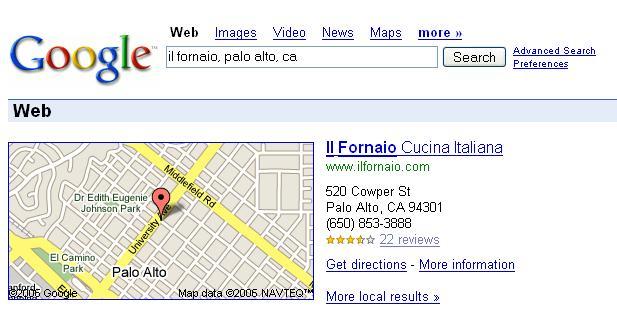
Looking for a place to eat?  You could go to Zagat.com, DineSite or CitySearch -- or you could enter the restaurant name into Google and get complete information including reviews.
7restaurant


The list continues -- whether you are looking for pictures, Movie times, weather, a calculator,  or medical information, Google has a vertical search OneBox to answer your question.

I think that vertical search engines can still succeed if they offer additional application-specific features/navigation that differ from traditional search-box functionality (like Krugle) or if they focus on syndicating their results across other sites (like Biggerboat).  But Google's actions have real consequences for vertical search engines -- and I'm surprised that there has been more discussion around Google Co-op than Google OneBox.  By implicitly determining a user's intent, Google is able to take standard queries and filter them to their vertically focused sub-sites.  Am I missing something or does this have real impact on the vertical search space?

Memories

I just found some old Half.com TV commercials on YouTube -- it sure brings back the memories...

Youtube1


Youtube2_1