Congratulations VideoEgg...
 AOL's Beta version of AOL Uncut went live today (via Techcrunch).

 espite being coastally challenged (currently living in Philadelphia), Josh has been an active entrepreneur and investor in the Internet industry since its commercialization. In 1992, while he was a student at the Wharton School of the University of Pennsylvania, Josh co-founded Infonautics Corporation – an Internet information company. In 1996, Infonautics went public on the NASDAQ stock exchange.
 or visit First Round Capital

AOL's Beta version of AOL Uncut went live today (via Techcrunch).
I just read the rumors about Jotspot being acquired. While I have no information as to the accuracy of the report, I wish for the best for Joe Kraus and team. Recently, I've been playing around with their new JotSpot Family Site that launched last week. I think Jotspot has been doing a great job of building specialized applications on top of a wiki framework. (Their tracker application is very slick).
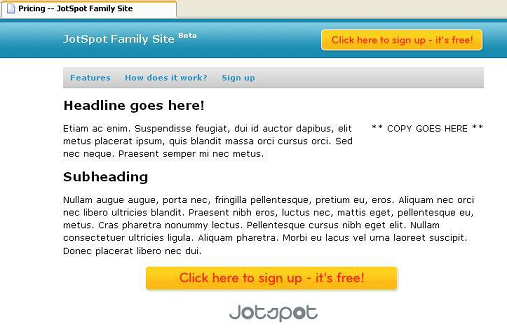
One thing I noticed while playing around with their Family Site, however, is that they are pretty up-front with the fact that their business model is still a work in progress. Check out their pricing page (at http://familysite.jot.com/pricing.php). Very refreshing! A Web 2.0 startup that admits that their pricing strategy is still unwritten...
[UPDATE: JOTSPOT NOTICED THE LINK AND FIXED IT. A SCREENSHOT OF THE ORIGINAL PAGE IS BELOW]
 One of the few benefits to being a technology investor
based outside of Silicon Valley is that I
don’t spend all my time in the valley. While I'm out in California every few weeks, I get to spend most of my time in the "real world."
One of the few benefits to being a technology investor
based outside of Silicon Valley is that I
don’t spend all my time in the valley. While I'm out in California every few weeks, I get to spend most of my time in the "real world."
Over the
last several weeks, I’ve been on several phone pitches from west-coast companies that are
looking to be the “flickr of XXXX” or “like del.icio.us but YYYY” or “the Digg
killer”. It got me thinking – how many people outside of the valley have
ever heard of these companies? I asked a bunch of local
(Philly-area) acquaintances and the answer came back loud and clear:
none – nada - zip. People here have barely heard of Myspace and
Craigslist – let alone any of the “hot” Web 2.0 companies.
As more and more entrepreneurs start building what Fred Wilson referred to as second derivative companies,
I think they run a big risk of designing a product/service that is targeted at
too small of an audience. Too many companies are targeting an audience of
53,651. That’s how many people subscribe to Michael
Arrington’s TechCrunch blog feed. I’m a big fan of Techcrunch – and read it every day. However, the Techcrunch audience is NOT a mainstream America audience.
A good review in Techcrunch can get a company their first
5-25K beta users very quickly. However, I’d strongly caution entrepreneurs from taking
their initial consumer adoption metrics and extrapolating them too far into the
future. I believe startups will find it difficult to cross the
“Techcrunch chasm” between the Web 2.0 geeks and Mainstreet USA.
If we could get access to the usage logs of the top 10 Web 2.0 properties, I would bet that their 10,000 most active users would all be the same.
As I evaluate new startups these days I’m finding it
harder and harder to see the big ideas that will appeal to a large, non-geek
consumer audience. Thoughts?
 There have been a number of wonderful blog posts debating whether this is a good or bad time to start a business. Fundamentally, I believe that the reason the debate is occuring is because there have been some fundamental changes to the risk/reward ratio involved in business formation.
When I started my first business (Infonautics Corporation) in the early ‘90’s, the cost to “get in the game” for an IT business was $4 - 5M (ie, first round was $4M). It took that amount to buy the expensive sun hardware, build a datacenter, write the custom software, and build the appropriate infrastructure to grow a business. When I started Half.com in the late ‘90s, our first round of VC was about $2.5M – we didn’t have to build our own datacenter, hardware costs were coming down, and although we had to write custom software we were able to use development tools that made it faster and cheaper.
In recent years, however, it’s gotten much cheaper to launch a software/Internet company. The power of open-source software, cheap Intel-based servers, a plethora of robust development environments, ASP-based services to handle backoffice processes (ie, at Half.com we had to build a help desk – now startups can use an ASP) --- combined with the rise of offshore development – have dramatically reduced the costs to “get in the game”.
This allows companies to bring a product to market for much less than was previously required. Companies are able to launch a product or service for under $1M. This changes the game for the entrepreneur – primarily because of the cap table.
If a company previously needed $4M to get off the ground, they would raise venture funding – which would leave them with a post-money valuation typically between $8 and $12M. In order for the VC to get a “win”, their target return would prevent the company from ever considering an exit below, say, $100M. (ie, no early-stage VC would call an exit at $36M – or a 3x return – a “big win”). These VC economics typically led companies to work toward exits in 3-7 years – to allow them to “grow into” the valuations required by the VC.
However, if today’s entrepreneur is able to get a company off the ground with $500K - $1M, they have additional options. For example, if an entrepreneur is able to raise $500K at a $2M pre-money valuation (or a $2.5M post), they have the option of considering an exit between the $15M and $50M range. Indeed, a sale at a price of $18M would provide investors with an 8x return (assuming a 1x liquidation preference). Moreover, at valuations in the $15-50M range, acquirers are willing to buy “technologies” or “market positions” – as opposed to businesses. (ie, to justify acquisition prices of >75M companies must buy revenues and pipeline, but at lower prices acquirers are essentially making a buy-versus-build decision on a technology or market positioning).
This trend has definite implications for entrepreneurs, angel investors and venture investors alike. And, I believe, requires a candid conversation between the entrepreneur and his/her prospective funders. While I know that there are no guarantees - and that plans change once a business is launched -- it is important for me to know, going in to a deal, what the entrepreneur's ideal outcome is.
A few additional comments:
• Companies must still build a product or customer base
of real value. (ie, if a company is
built solely with a “flip” in mind – chances are that it will be able to take
neither track (ie, no VC and no buyer).
• I believe that
this trend could actually be a benefit for venture funds in the long run. Since companies can get further along on seed-stage capital, VC’s are
seeing business with reduced risk. VC’s
can see actual product/market acceptance prior to investing. This also plays nicely with the fact that
VC’s need to deploy larger amounts of capital (given their fund sizes).
 A few weeks back, I wrote a blog post (on Bridge Loans versus Preferred
Equity) that briefly
mentioned the National Venture Capital Association’s Model Legal Documents for
a Venture Capital financing. I am a heavy user of these documents (having
found them to be tremendously valuable in our negotiation process) and thought it would be worth going into some greater detail here.
A few weeks back, I wrote a blog post (on Bridge Loans versus Preferred
Equity) that briefly
mentioned the National Venture Capital Association’s Model Legal Documents for
a Venture Capital financing. I am a heavy user of these documents (having
found them to be tremendously valuable in our negotiation process) and thought it would be worth going into some greater detail here.
These documents were drafted to offer a "template" set of public domain model legal documents that are "fair
[and] avoid bias toward the VC or the company/entrepreneur" and reflect "current practices and customs". By providing these documents, the NVCA has
made my job much easier. I routinely use
the NVCA docs as the baseline for First Round Capital's term sheets. Doing so allows me to (1) clearly communicate to
entrepreneurs that I am not looking for any non-standard terms, (2) reduce the legal fees of both parties, and (3) get a deal closed much faster than I would if I had to start from scratch. The documents also note where the East coast and West coast differ in their standard terms - a feature which has been useful as I invest bi-coastally.
A little more about the documents:
The documents were drafted by a working group of law firms and venture firms and are updated annually. You can check out the current members of the working group here.
The documents include a model Term Sheet, Stock Purchase
Agreement, Certificate of Incorporation, Investor Rights Agreement, Voting
Agreement, Right of First Refusal and Co-Sale Agreement, Management Rights
Letter, and Model Indemnification Agreement.
"Annually, our industry closes several thousand financing rounds, each consuming considerable time and effort on the part of investors, management teams and attorneys. A conservative estimate is that our industry spends some $200 million in direct legal fees annually to close private financing rounds. In an all-too-typical situation, the attorneys start with documents from a recent financing, iterate back and forth to get the documents to conform to their joint perspective on appropriate language (reflecting the specifics of the deal and general industry best practices), and all parties review numerous black-lined revisions, hoping to avoid missing important issues as the documents slowly progress to their final form. In other words, our industry on a daily basis goes through an expensive and inefficient process of "re-inventing the flat tire." By providing an industry-embraced set of model documents which can be used as a starting point in venture capital financings, it is our hope that the time and cost of financings will be greatly reduced and that all principals will be freed from the time consuming process of reviewing hundreds of pages of unfamiliar documents and instead will be able to focus on the high level issues and trade-offs of the deal at hand."

Back in the Web 1.0 days, we
saw the rise
and fall of
the barter/swap business model with companies such as WebSwap, Switchouse, Swap.com, SwapVillage,
Mr. Swap, etc). These sites received tens of millions of dollars from well known VCs but none of them were able to gain traction or survive the
fallout. It might be my false pride, but I believe that consumers were
more attracted to person-to-person fixed price sites (such as Half.com and
Amazon Marketplace) where they could swap their CDs/DVDs/Books for cash.
As Forbes magazine wrote in 2000: “It
took humans thousands of years to emerge from the barter system. Does bringing
it back online make sense?”
It seems that with the emergence of Web 2.0 we now have a
rush of companies looking to take up where the others left off. Over the
last few months we’ve seen the emergence of Lala, Zunafish, Barterbee along
with Peerflix.com. Further support for Om's argument that Web 2.0 is Web 1.0 all over
again. In fact,
last week’s New York Times article on Zunafish looks remarkably similar to the one they ran almost
six years earlier.
All of these new sites are looking to build a
barter/swap-based business model. However, the Web 2.0 barter sites represent a meaningful advance from the Web 1.0 barter sites. Rather
than force users to conduct a two-way swap (ie, User A has something that User
B wants AND user B has something that User A wants) they’ve introduced a point
system (or alternate form of currency) to allow users to conduct one-way swaps (ie, User
A gives something to User B for 4 points – and User B can get something from
user C for those points). Users pay a standard fee (typically $1) to make
a trade.
The currency/point model is a
significant improvement. Users can now get something without having to
find someone who wants something from them. Recent blog posts have
compared the efficacy of this new model to the cost of buying/selling used
goods. However, I’m still not convinced that a swap/barter marketplace is as effective as a cash marketplace.
I
spent some time tonight looking at the currency value of DVD’s on
Peerflix. Specifically, I compared the used price of several DVDs on
Half.com to their Peerbux price – and found the values to be highly
disproportional. (I chose Half.com since it is a liquid marketplace that
places a dollar value on used DVD’s – and since I founded it – but the analysis
holds in Amazon Marketplace as well)
For example, you can get both the Fourth and Fifth Season of the
Sopranos on Peerflix for 10 Peerbux each. However, on Half.com you can currently buy the
Fourth Season for $29.99
and the Fifth Season for $38.00. That means that there is an eight dollar price difference between two DVDs worth the same number of Peerbux. So a user who gives away their Fifth Season Sopranos for 10 Peerbux is not just paying a $1 swap
fee – they are leaving another $8 on the table. Moreover, Peerflix users
can buy Peerbux for $5 each. So, if you wanted to get the Fourth Season
of the Sopranos on Peerflix by purchasing Peerbux, you’d be paying $50 – or $20
over market value. Badda bing!
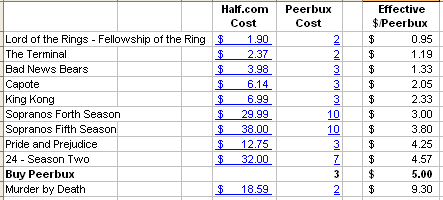
I selected a total a ten DVDs and then computed the implied
cash value of a Peerbuck (by dividing the price on Half.com by the price in
Peerbux).
I was surprised to
see that the price of 1 Peerbuck ranged from $0.95 all the way to $9.30.
This has two consequences. First,
it creates a “winner” and a “loser” in every trade. In a true marketplace, both sides of the transaction get a fair deal. However, if you “sold” your copy of 24 (Season Two) or
Murder by Death on Peerflix you did not get as good as deal as someone who
“sold” their Lord of the Rings or Bad News Bears. By using a point system
instead of real dollars, these marketplaces hide the true cost of the
trade -- and are always putting 50% of their users at a financial disadvantage.
Second, people will want to keep the good DVDs they have, while they're willing to trade the bad ones (via Techdirt). This creates a real arbitrage opportunity. I went on Peerflix and listed several of the
low value items for trade (Lord of the Rings, The Terminal, Sopranos Fourth
Season, Bad News Bears). If I get an
order, I’ll go to Half.com and have the DVD’s shipped to the Peerflix
customer…then I’ll use my new Peerbux to buy Murder by Death or 24 (Second
Season) – and then sell those on Half.com. It should be an interesting experiment – I’ll keep you informed…

