Redeye VC

Josh Kopelman

Managing Director of First Round Capital.

espite being coastally challenged (currently living in Philadelphia), Josh has been an active entrepreneur and investor in the Internet industry since its commercialization. In 1992, while he was a student at the Wharton School of the University of Pennsylvania, Josh co-founded Infonautics Corporation – an Internet information company. In 1996, Infonautics went public on the NASDAQ stock exchange.

Read more or visit First Round Capital

Known Unknowns

Question


"There are known knowns; there are things we know we know. We also know there are known unknowns
," Donald Rumsfeld


Most VC’s have a hard time passing on a deal or giving a “firm no”. Instead, startup entrepreneurs are often told “you're too early for us now, but call us when you get some traction.” As a seed-stage investor that’s not a line I can use.  Many of the deals we see are for a pre-launch companies with incomplete teams, unproven technology, and unknown/evolving business models, etc.


One of the most common mistakes founders make at this stage is to assume that investors expect them to have all the answers. When asked about their advertising sales projections, the founder often launches into a five minute explanation as to why their numbers are conservative – when the real answer should be I "don’t know what the sales numbers will be, but here were the assumptions I used.”


Rather than have a founder defend every assumption to the death, I’ve often found that my most productive sessions with entrepreneurs occur when, together, we try understand the different risks facing the business. While Donald Rumsfeld has been criticized for his comment about “known knowns”, I actually think he was onto something. When I review a new opportunity, I like to divide the risks into three categories:

 
Known Knowns
These are the assumptions that have some proof or external validation. For example, if your customer acquisition model is based on customer acquisition using paid search, I’ve found that spending $200 on Google Adwords could provide you with some real-world data on your cost to acquire a customer. If you’re trying to build a subscriber base and you have a beta site operational, you might be able to get some real world conversion data to use in your model.  The known knowns are easy to model.

 
Known Unknowns
These are the assumptions that we don’t have actual data on.  Say your business plan has an assumption that there will be a viral element to your customer acquisition strategy but you don’t have any hard data to base your model on.  In this case, I often like to see if we can get any third-party data to use for comparison purposes. While you might not know what your viral customer acquisition model is, can you get data from analysts, public company statements or similar sites?  If not, I like to see entrepreneurs build a financial model that includes a sensitivity analysis.  This allows you to take a variable (say cost-per-acquisition) and see how it impacts your financial model with different assumptions.

 
Unknown Unknowns
These are risks that we don’t even know exist – typically the only way we learn about them is after an issue has raised its ugly head. These issues often result from an unanticipated consequence of an internal decision, unanticipated moves by a competitor, economic shifts, etc. While you try your best to anticipate all eventualities, these are the risks that you often can’t control or plan for.  This is one area, however, where having an experienced VC/mentor/advisor could really add value – by helping to build a variety of companies, they can take advantage of “pattern recognition”.


Before you go out to raise money, make sure you know what you don't know...


Thanks to my friend Ed Watkeys for reminding me of the Rumsfeld quote!

Welome Aboard Chris!

Chris Fralic starts at First Round Capital today.  (More info here -- in pdf format).

I've known Chris for almost 10 years now -- he was the first executive hire we made at Half.com -- and I'm really excited to be working with him again.   He's seen it all and has been around the technology industry for 20+ years with stints at Oracle, AOL, Half.com, eBay, del.icio.us, and Yahoo

Welcome aboard Chris - we sure can use the help!

Fundraising from A-Z

Abc

We just received this email today...I wish them the best of luck.


From: [Hidden to Protect the Offending Party]
Sent: Tuesday, March 14, 2006 10:45 AM
To: ****@eglholdings.com; ****@eldorado.com; ****@epvc.com; ****@equuscap.com; ****@equuscap.com; ****@firestarter-llc.com; ****@firstnewenglandcapital.com; ****@firstround.com; ****@fisherlynch.com; ****@fequity.com; ****@fflpartners.com; ****@frontenac.com
Subject: [Hidden to Protect the Offending Party]

Dear potential investors:

I am the owner of [Hidden to Protect the Offending Party]. I am interested in submitting our business plan in an effort to discuss our plans…


LinkedIn Profitable

LinkedinCongratulations to Reid, Konstantin and the whole LinkedIn team for reaching profitability.  It's been a lot of fun watching them efficiently execute without losing their customer-focus.  While there's still work to do, they clearly have proven some of the doubters wrong.  I think Reid is one of the savviest consumer Internet guys in the business - and I continue to be thankful that he allowed me to participate in their angel round...

"le" magic...(or, Bubble ends in "le")

1995-2000 was the era of the "SCAPES" (Netscape, Medscape, Wellscape, etc.).


2000-2004 brought the era of the "STER" (Napster, Feedster*, Friendster, Dogster, Eurekster, etc.).


And now, I believe, we have now entered into the era of “LE”. While some might argue that flickr's success has made "kr" is the Official Suffix of Web 2.0, I disagree. After Google’s phenomenal success, there’s beenLe_2 an influx of companies wanting some "le" magic. Google itself launched Froogle. Now we have Kaboodle, Kanoodle, Azoogle, Oodle, Ookle(s), Rabble, Dabble, Zazzle, Taggle, Quimble, and Krugle*.


So, here’s my thought – some web hacker should build an "le" crawler to search the whois database for all available "le" domain names. This way we can determine when all of the “le” domain names are taken – giving us Web 2.0 investors some advance knowledge of when the music will stop… For now, I think we’re safe – kafroogle.com, kabloodle.com, and shlurfoodle.com are still available.

I can’t wait to see their business plans.


*Note - I am a happy investor in Feedster and Krugle...

Another reason to blog...

Last week Michael Arrington of Techcrunch ran a small entry about two deals we've funded -  Aggregate Knowledge and BazaarVoice.  He was kind enough to include a link to the First Round Capital website.

Techcrunchtraffic
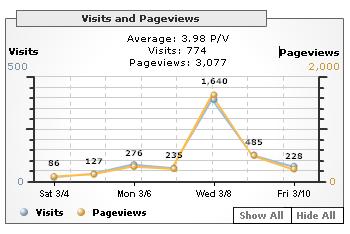
When I took a look at my Google Analytics data for firstround.com, I was surprised to see the real surge in traffic that one (well-placed) blog link can bring.  Our page views increased about 8x the normal daily average.  Not bad for one link in a small story.
Dealflow
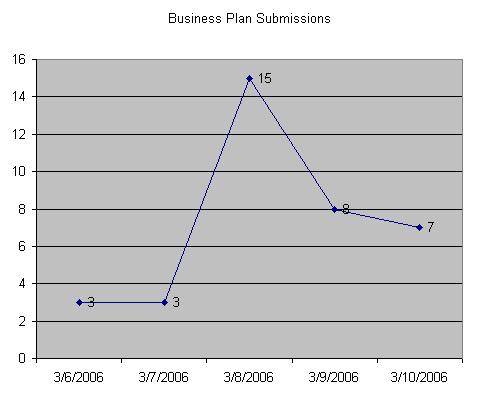
Just today I took a look out our dealflow log -- where we log all inbound dealflow.  I was surprised to see a corresponding spike in dealflow -- and that the increase in submissions persisted far longer than the increase in web traffic. 

It got me wondering - what deals have I missed out on by not being part of the online conversation?


VIP Treatment

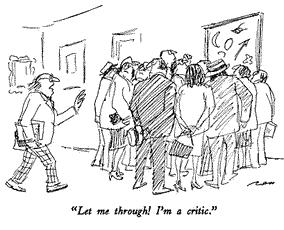
CriticWhen a restaurant owner recognizes a food critic in their restaurant, the critic gets extra-special treatment.  To be a good restaurant critic, you have to be anonymous.  Otherwise, the critic's "picture is posted in every four-star, low-star, and no-star kitchen in town" and they get special service. 


Restaurant owners understand the power of the press -- and go to extreme efforts to ensure that influential customers have a wonderful experience. 
This isn't rocket science -- it's good business! 


Why is it that online businesses don't do the same?  They should!  One of the first things we did after we launched Half.com was create a VIP list, containing the email addresses of all influential reporters, competitors, potential acquirers, analysts, and investors.  (Bloggers didn't exist back then - but they would qualify as well).  We then had our system alert us whenever a VIP created an account, purchased an item or listed one for sale.  When a VIP purchased a CD we'd have someone from our customer service group telephone the seller to confirm that it shipped promptly.  When a VIP listed an item for sale, we'd monitor it to see if it sold.  And if a (hypothetical) reporter listed a (hypothetical) book for sake, and it didn't sell quickly, a relative of a
(hypothetical) Half.com employee in Oklahoma might (hypothetically) purchase the item...Resulting in a (hypothetical) story in the New York Times


Half.com offers a good service -- just like most restaurants serve good food.  But, doesn't it make sense to be on your best behavior with influential customers?

Do you have a VIP list for your company?  Do you know what experience journalists, bloggers, analysts and acquirors are having with your product?