Redeye VC

Josh Kopelman

Managing Director of First Round Capital.

espite being coastally challenged (currently living in Philadelphia), Josh has been an active entrepreneur and investor in the Internet industry since its commercialization. In 1992, while he was a student at the Wharton School of the University of Pennsylvania, Josh co-founded Infonautics Corporation – an Internet information company. In 1996, Infonautics went public on the NASDAQ stock exchange.

Read more or visit First Round Capital

Converting data exhaust into data value

I've written frequently about my thoughts on the Implicit Web.  As more consumers spend more time online (and perform more of their activities online), they leave a trail of digital breadcrumbs exposing data about themselves and their interests.  This "digital exhaust' is often massive -- requiring terabytes of data and log files.  And while storage costs are coming way down, it is still typically too expensive for companies to analyze all their historical data.  Instead, companies frequently resort to sampling or archiving.  And for those companies that do try to retain and analyze historical data, they typically find that their database queries take hours or days.

That's why I'm so excited that First Round Capital portfolio company, Aster Data Systems, has launched today -- after three years in stealth mode.  Google and Yahoo power their sites using databases distributed across many clusters of servers.  Aster Data offers clustered databases for web analytics -- and today announced that they are already supporting Myspace (which is running a 100 server node cluster across hundreds of terabytes) and Aggregate Knowledge's Pique service (which is performing analysis on over 100 million users). 

As more companies seek to transform their data exhaust into data value (hey wait a minute -- perhaps that's the Web 2.0 version of "clean tech" -- converting messy data into clean insight) -- I think they will need tools like Aster Data to help them discover deep insights on massive data sets.  More information on Aster can be found on their website and blog.

Facebook's new Fortune 500 Advertiser...

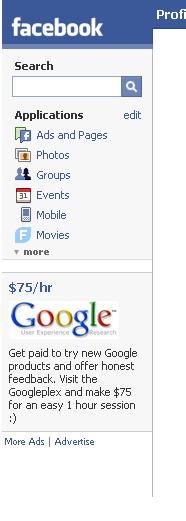
Googfb While the blogosphere buzzes about Facebook's banning of Google Friend Connect, it appears that Google is not entirely a "persona non grata" at Facebook.  It seems that Google, the Internet advertising superpower, is actually purchasing advertising on Facebook's Ad Platform.  As you can see from this ad (right) from Facebook, Google is seeking candidates for their User Experience Research. 

Maybe Google wanted to test out Facebook's social ad targeting platform.  Or maybe they just wanted to recruit the candidates outside of the Google footprint.  Either way, I'm glad to see the two companies getting along ;-)

Oh -- and you can check out more information on Google's User Experience Research program here and here.

The "Atomization of Conversation"

Atom Last week I was speaking with Lawrence Hooper of Loladex and he used a phrase that's been sticking in my head.  When I asked him whether people would be willing to solicit their friends to make a local recommendations via his Facebook application -- he said how he believed his site represented the continued "atomization of conversations."

It's interesting to think about -- as more applications get connected to the social graph, conversation and dialog are being atomized.  If the current "geek" technologies go mainstream, you will no longer need to have a broad conversation about anything. 

  • Why call someone and tell them you're coming to town?  They've seen it on Dopplr
  • Want to tell someone about your recent trip to England?  Don't bother, they've seen the pictures on Flickr. 
  • No need to call me and ask whether the new movie I just saw is any good -- you've seen my review on Flickster
  • Want to know what music I'm listening to right now? -- check out iLike.
  • Is someone you know suffering from an illness or injury? -- stay connected and informed (and offer support) at their Carepage.
  • Did your friend just open a bottle of wine?  You can stay up to date on what they like (and don't) by following their CellarTracker reviews.
  • And if that didn't cover it, don't worry, you probably saw it in my Facebook Status updates or Twitter feed.


Conversations are indeed becoming atomized and asynchronous.  No need for the "Hey, how are you doing?" discussion.  Personal dialog is being replaced by a Mini-feed. 

Pro - David Levine says it best "Atomization means conversations are more powerful and real ones have more true content."

Con - There's something special and genuine about a conversation -- the anecdotes, personality and emotion don't come across the same in a 160 character SMS message.

Top Ten Tech Trends

Vcpanel


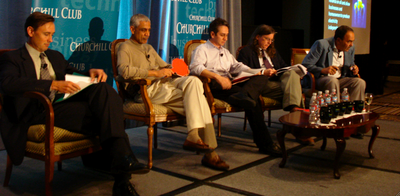
Photo from VentureBeat


I just returned from participating on the Churchill Club's annual "Top Ten Tech Trends" panel.  Quite an amazing event -- they pick five VC's for the panel and each gets to present (and defend) two trends for the coming year.  With a panel consisting of Khosla, Jurvetson, Schoendorf, McNamee and Kopelman, I felt a little like I was part of a "Which One Of These Things is Not Like The Other" puzzle...but overall I think I did OK for a "rookie".  (I discussed the Implicit Web and a pending shakeout in VC as my two top trends).  A good summary of the event and all 10 trends can be found here, here and here

Oh, and while I know I have no chance of becoming an "A List" blogger, it appears that I've made the B-Z List.  (Or at least according to The Industry Standard).

Blist_2

Lifecycle Messaging

I recently blogged about the importance of conducting a cohort analysis to track user retention.   A good cohort analysis helps you understand how many customers you keep and how many you lose.  So now what?

I'm surprised how little pro-active messaging/communication most Internet companies do.  And if they do send me an email, it tends to be a generic weekly promotional email that they send to all users.  One thing that I learned at half.com is the importance of lifecycle messaging -- in which you deliver different messages to different users based on where they are in their lifecycle.  Some examples:

  • The average fiction book is read within two weeks of purchase.  So if you purchased a John Grisham book for $8.75 on Half.com, chances are that you will finish it within 14 days.  We decided to implement an auto-email that was sent 17 days after purchase that said "Want your $8.75 back, click here to list your Grisham book for sale".  We found that the open (and conversion) rate of that email was amazing -- and it greatly added to our ability to "turn" the same book multiple times.
  • We noticed on our cohort analysis that if a first-time buyer did not make a second-purchase within 6 weeks of their initial purchase, there was a 80%+ chance that they would not return -- but that if a user made two purchases within that period of time, there was a 70+% chance they would return again.  So we created an auto-email with a personalized, limited-time coupon that was sent after six weeks.  Again, we experienced strong open/conversion rates.
  • We noticed that if a buyer left negative feedback on a transaction it had a definite impact on their repeat purchase behavior -- so we created a customized email campaign towards those users.
  • Like all e-commerce sites, Half.com had many "abandonded shopping carts" -- where people would put items in the cart and not check out.  We created an auto-email campaign that would merchandise the items left in the cart -- and send it out two hours after the cart was abandoned.  A very successful campaign.

And while these are examples of lifecycle messaging by email -- you can do the same thing on the site as well.  Many sites still display the same homepage for first-time and repeat users.  The leading e-commerce sites added personalized home-pages long ago -- so they can deliver different messages to new users (education, introduction, tutorials) and to repeat users (personalized recommendations, promotions).  If you'd like to see a good example, go to eBay as an existing user -- then delete your eBay cookies from your browser and return.

Conducting a cohort analysis is just the first step towards increasing user retention and activity levels.  Once you have your cohort analysis, you then should look at ways to systematically reduce churn and increase user satisfaction - by finding the key "touchpoints" which can dramatically change the course of a user's experience.  This is not rocket science, but despite the fact that Jupiter Research data indicates that lifecycle marketing campaigns generate as much as nine times greater results, few marketers are taking advantage of this strategy to deliver the right message at the right time.   

My co-founder at Half.com, Sunny Balijapalli, has recently started a new company (Zoomin.com - which was rated the #1 photo sharing and printing service in India by PC World) that First Round Capital has funded.  Not surprisingly, one of his first priorities was to put together a lifecycle messaging program.  With his permission, I've attached a copy of his program overview here.

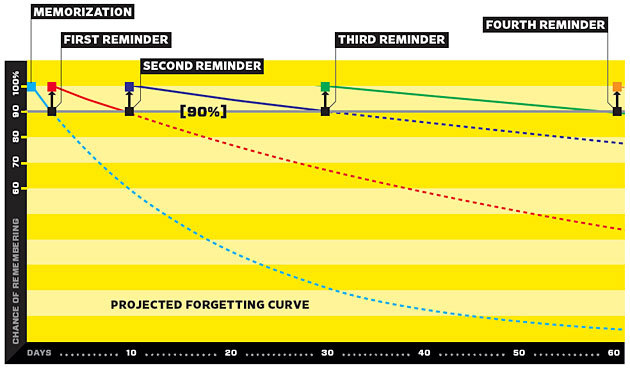
A small digression.  The current issue of Wired Magazine discusses the "spacing effect" for human learning -- which recognizes that if a person is reminded of a fact at certain specified intervals, they are far more likely to remember the fact later.  (See chart below from Wired).  I think the metaphor can be extended to consumer marketing as well -- if you communicate with a user during certain specific intervals, they are far more likely to return to the site later.  They key is to figure out what those intervals are -- and what "triggers" you should use to drive the communication.

Ff_wozniak_graph_f

How to "Ask for the Order"

Sign I just read Fred Wilson's blog post about the need to ask for the order.  I completely agree -- if you don't ask, you don't get. 

However, I believe that there are different ways to ask for the same order.  And the way that you ask can either increase or decrease the odds of a successful outcome.  Some examples:

Before we launched Half.com, we knew that we needed to have a lot of  inventory on the site -- so we reached out to dozens of used bookstores, CD stores and video shops.  We had a team of three business development people working full-time to get these sellers to agree to list on our site.  Initially, we would call a prospective seller, explain our site/model, and if they were interested, we'd "ask for the order" and send them our standard three-page seller agreement.  Despite our best efforts, we found that small retailers were either intimidated by our agreement or didn't want to spend the money to have a lawyer review it. More than 60% of the interested sellers would drop out of the process before they signed the agreement.

We then made a slight change.  Instead of sending them a three-page legal agreement to physically sign, we added a click-wrap agreement to our site.  We then asked the sellers to register online, and during registration we simply asked the seller to agree to our terms of service by clicking a box.  Instantly, we eliminated our biggest challenge in getting sellers on board.  Because in this case, users are far more willing to agree to terms on a website than they are to sign a three-page contract.  We didn't change what we asked for -- we just changed the way we asked for it.

One of my portfolio companies recently experienced the same thing.  They were talking with a variety of prospects about a big advertising deal.  And initially my company was sending out an "Advertising Partnership Agreement" -- outlining the full terms of the relationship.  They quickly learned that all  non-standard agreements had to go to legal -- which added weeks/months to the process. 

So the company decided to try a change.  Instead of sending over a custom agreement, they sent over benign looking  "Ad Insertion Agreement" which had the exact same terms of our prior agreement.  Our marketing contact had full authority to sign an ad insertion agreement -- they do that all day long -- and now my company is able to get deals signed much faster by changing the format of our "ask".

The list continues.  When TurnTide wanted to send out a free evaluation unit of their anti-spam router, they originally had a long written agreement.  When they changed the format of their agreement to a one-page trial acceptance form, they cut weeks off their sales cycle. 

Say you work at Google and you want to get a prospective partner to sign an NDA.  You can send someone your NDA document and it goes to their lawyer.  There will probably be a bunch of back-and-forth on the terms.  That's pretty time consuming.  However, why not do it the easy way?  Just invite the guy over to lunch on Google's campus. 

Because whenever anyone gets a visitor badge at Google they are asked to sign an NDA as part of their visitor badge process.   I'm sure glad everyone brings a lawyer to help them sign-in at reception ;-)

The way you ask is just as important as asking.  If you focus on reducing friction in a transaction -- and ask for the order in the right way -- you might find that you improve both your odds of success and the time needed to get a deal done...

How smart are you?

Think you're pretty smart?  Prove it.

Tomorrow night, Playcafe.com (a First Round Capital portfolio company) will be hosting Ken Jennings.  Ken is the guy who won 74 games in a row (and over $3 million) on Jeopardy.  But on Jeopardy Ken only had to beat two other players a night.  On Monday night, Ken will be playing against the world.

Playcafe is a recent First Round Capital investment that is creating the first online game show network. Traditional game shows such as "Deal or No Deal" and "One vs. 100" are among the most popular programs on TV (nine of the top 20 shows, 200 million viewers) but they weakly implement a game's two most important traits - interactivity and socialness.  PlayCafe is creating a platform to stream in-house and user-generated game shows that let every viewer be a contestant.

While I've previously written about the importance of admitting what you don't know, tomorrow night is all about proving what you do know.  Give PlayCafe.com a try tomorrow night, this Monday, April 28th from 6:00-8:00 pm (PDT).   Who knows, you might beat Ken.

Kenjennings_2